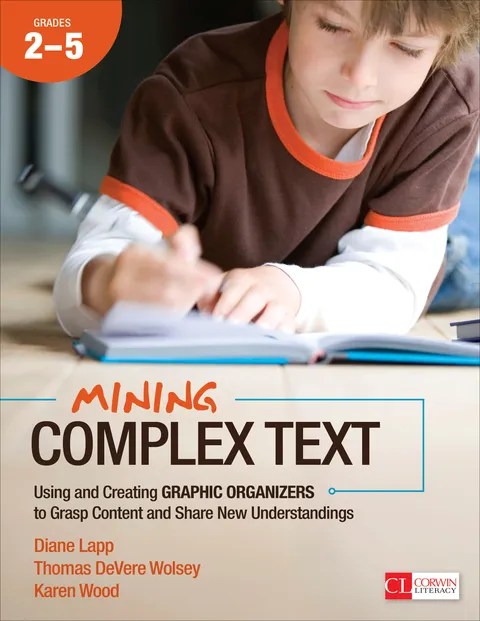
Mining Complex Text, Grades 2-5
Using and Creating Graphic Organizers to Grasp Content and Share New Understandings
Report an issue
Tell us what's wrong and we'll take a look.
Thanks – we got it. We'll review and follow up if needed.
"How many times have you heard ‘a picture is worth a thousand words.’ . . . In this text, Lapp, Wolsey, Wood, and Johnson make a vital connection between reading words and the role of graphics. They demonstrate how teachers and students can blend the two such that great learning occurs in every classroom, every day."
—DOUGLAS FISHER
Coauthor of Rigorous Reading
Imagine you are a fourth grader, reading about our solar system for the first time. Or you’re a high school student, asked to compare survival in Suzanne Collin’s The Hunger Games and Elie Wiesel’s Night. Reading complex texts of any kind is arduous, and now more than ever, students are being asked to do highly advanced thinking, talking, and writing around their reading. If only there were ingenious new power tools that could give students the space to tease apart complex ideas in order to comprehend and to weld their understandings into a new whole.
Good news: such tools exist. In the two volumes, Mining Complex Texts, Grades 2-5 and 6-12, a formidable author team shares fresh ways to use the best digital and print graphic organizers in whole-class, small-group, and independent learning. Big believers of the gradual release method, the authors roll out dozens of examples of dynamic lessons and collaborative work across the content areas so that we see the process of using these visual tools to:
- Help students read, reread, and take notes on a text
- Promote students’ oral sharing of information and their ideas
- Elevate organized note-making from complex text(s)
- Scaffold students’ narrative and informational writing
- Move students to independent thinking as they learn to create their own organizing and note-taking systems
Gone are the days of fill-‘em-in and forget-‘em graphic organizers. With these two volumes, teachers and professional development leaders have a unified vision of how to use these tools to meet the demands of an information-saturated world, one in which students need to be able to sift, sort, synthesize, and apply knowledge with alacrity and skill.
Thomas DeVere Wolsey
As a teacher for online courses hosted by the University of Central Florida, Dr. Thomas DeVere Wolsey is interested in how the interactions of students in digital and face-to-face environments change their learning. While much of his research centers on how visual information, such as graphic organizers, works in tandem with text to improve learning, he is also intrigued by the intersections of traditional literacies with digital literacies, specifically focusing on how those literacies affect teacher preparation and professional development.




Why Readwise Books?
Readwise Books is an ebook & audiobook platform that automatically logs how much you and your friends read, making it fun and easy to read more. Learn more →