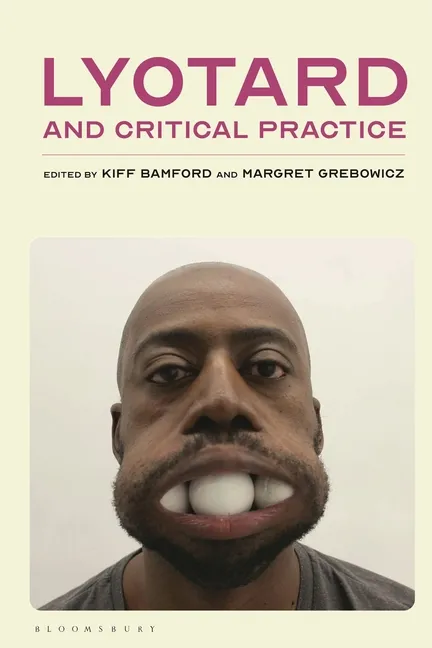
Lyotard and Critical Practice
Report an issue
Tell us what's wrong and we'll take a look.
Thanks – we got it. We'll review and follow up if needed.
Jean-François Lyotard (1924-1998) was one of the previous century's most provocative thinkers. Can his work help us address the crisis currently facing the humanities?
The dominant economic discourse sees the humanities as "low-value," an irritation at best. Lyotard helps us to think against this pervasive dismissal of creative activity, not by defending the honor of the humanities, but by inviting critical practices which aggravate this irritation. Critical practices trouble what counts as critique, embrace incertitude, and listen for silenced voices.
Twelve essays by artists and researchers take up Lyotard's invitation and begin to develop the idea of critical practice in the contemporary context. Three sections titled "What resists thinking;" "Long views and distances" and "Why art practice?" address contemporary concerns like affectivity, aesthetics, economic imperatives, militarism, pedagogy, posthumanism, and the closure of what in Lyotard's time was called "the West."
Four short pieces by Lyotard intervene in and buttress the discussion: "Apathy in Theory" and "Interview with Art Présent," here published in English for the first time, and "Affect-phrase" and "The Other's Rights" republished here to highlight his prescient concern for that which cannot be articulated.
Kiff Bamford
Kiff Bamfordis Reader in Contemporary Art in the School of Art, Architecture and Design, Leeds Beckett University, UK. He is author of 'Lyotard and the figural in Performance, Art and Writing' (Bloomsbury, 2012) and 'Jean-François Lyotard: Critical Lives' (2017).


Why Readwise Books?
Readwise Books is an ebook & audiobook platform that automatically logs how much you and your friends read, making it fun and easy to read more. Learn more →