Report an issue
Tell us what's wrong and we'll take a look.
Thanks – we got it. We'll review and follow up if needed.
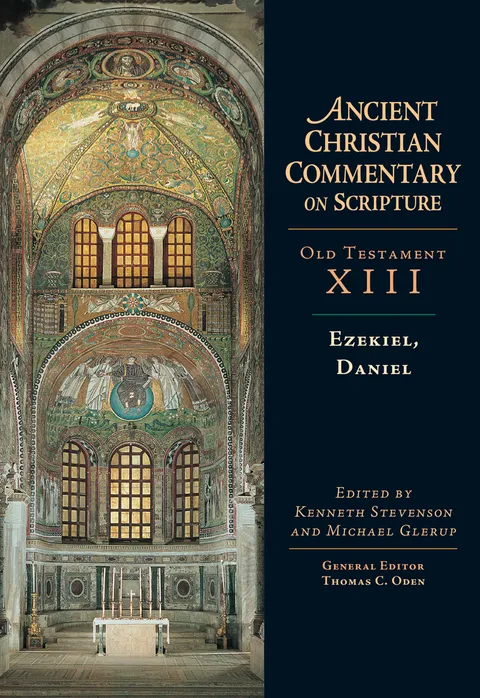
The books of Ezekiel and Daniel are rich in imagery that is taken up afresh in the New Testament. Echoes of Ezekiel--with its words of doom and hope, vision of a new temple, and scroll-eating prophet--are especially apparent in thebook of Revelation. Daniel is most notable in supplying terminology and imagery for Jesus of Nazareth's favored self-description as "Son of man," a phrase also found in Ezekiel. The four beasts of Daniel find their counterparts in the lion, ox, man, and eagle of Ezekiel and Revelation. It is no wonder these books, despite the difficulties in interpreting them, took hold on the imagination of the early church.
In this Ancient Christian Commentary on Scripture volume, over forty church fathers are cited in the commentary on Ezekiel, some of whom are here translated into English for the first time, but pride of place goes to four significant extant works: the homilies of Origen and Gregory the Great, and the commentaries of Jerome and Theodoret of Cyr, thus bridging East and West, North and South.
A similar array of fathers are found within the commentary on Daniel. Extensive comments derive from the works of Theodoret of Cyr, Hippolytus, Jerome, and Isho'dad of Merv, providing a wealth of insight.
Kenneth Stevenson
Kenneth Stevenson (PhD, Southampton University) is retired from his position as bishop of Portsmouth in England. A fellow of the Royal Historical Society, he is the author of numerous publications, including Worship: Wonderful and Sacred Mystery, The Mystery of Baptism in the Anglican Tradition, The Lord's Prayer: A Text in Tradition, and Rooted in Detachment: Living the Transfiguration.
Michael Glerup
Michael Glerup (Ph.D., Drew University) serves as the research and acquisitions director for the Ancient Christian Commentary on Scripture and as the operations manager for the Ancient Christian Texts series. He continues his research in the history of exegesis as the director of the Early African Christianity Projects and as the executive director of the Center for Early African Christianity at Eastern University.
Thomas C. Oden
Thomas C. Oden, the retired Henry Anson Buttz Professor of Theology and Ethics, is an ancient ecumenical evangelical with a passion for orthodoxy. For over thirty years he taught at Drew University and came under the influence of his “irascible, endearing Jewish mentor” Will Herberg. Herberg bluntly told Oden that he would remain “densely uneducated” unless he “read deeply in patristic writers.” This focus on patristics (the early church fathers) helped professor Oden to realize that modernity is over. As he probed the early church writers for several decades, he incorporated and rechanneled his activism and idealism for the modernist social gospel into a recovery of the classic religious tradition. Scripture found new life in him, which means he repented an enthrallment with progressive social causes in favor of a stable two-thousand year memory, which he defines as orthodoxy.


Why Readwise Books?
Readwise Books is an ebook & audiobook platform that automatically logs how much you and your friends read, making it fun and easy to read more. Learn more →