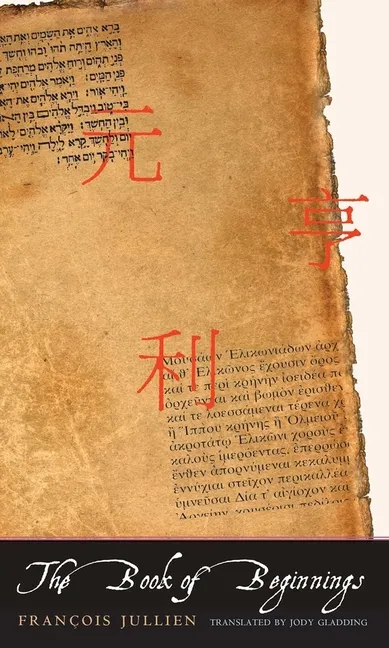
The Book of Beginnings
Report an issue
Tell us what's wrong and we'll take a look.
Thanks – we got it. We'll review and follow up if needed.
How can a person from a Western culture enter into a way of thinking as different as that of the Chinese? Can a person truly escape from his or her own cultural perspectives and assumptions? French philosopher François Jullien has throughout his career explored the distances between European and Chinese thought. In this fascinating summation of his work, he takes an original approach to the conundrum of cross-cultural understanding.
Jullien considers just three sentences in their original languages. Each is the first sentence of a seminal text: the Bible in Hebrew, Hesiod's Theogony in Greek, and the Yijing (I Ching) in Chinese. By dismantling these sentences, the author reveals the workings of each language and the ways of thought in which they are inscribed. He traces the hidden choices made by European reason and assumptions, discovering, among other things, what is not thought about. Through the lens of the Chinese language, Jullien offers, as always, a new and surprising view of Western culture.
François Jullien
François Jullien is Professor at the Université Paris VII-Denis Diderot and director at the Institut de la Pensée Contemporaine, France. He is the author of Detour and Access: Strategies of Meaning in China and Greece (2004), The Propensity of Things: Toward a History of Efficacy in China (1999), and In Praise of Blandness: Proceeding from Chinese Thought and Aesthetics (2004).
More by François Jullien





Jody Gladding
Translated by
Jody Gladding is a poet and translator. She has published three full-length collections of poetry and translated nearly 30 books from French. Her awards and honors include MacDowell and Stegner Fellowships, a Whiting Writers’ Award, and a Yale Younger Poets Prize. She lives in Vermont.


Why Readwise Books?
Readwise Books is an ebook & audiobook platform that automatically logs how much you and your friends read, making it fun and easy to read more. Learn more →