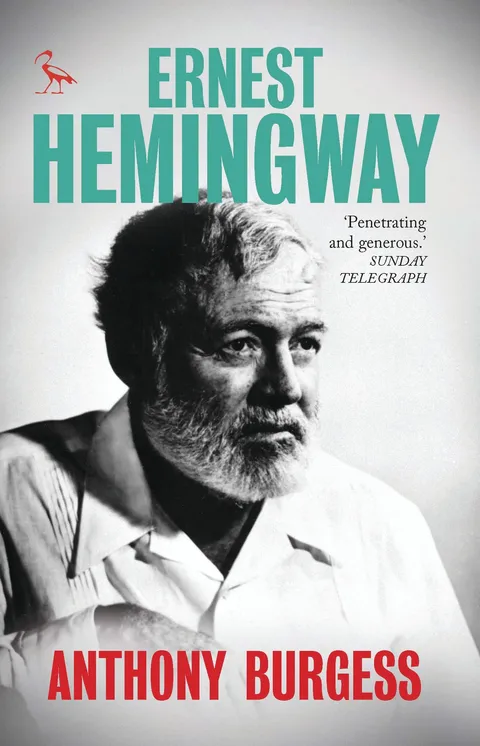
Ernest Hemingway
Report an issue
Tell us what's wrong and we'll take a look.
Thanks – we got it. We'll review and follow up if needed.
He was six feet tall, huge-chested, handsome, ebullient, a warrior, a hunter, a fisherman, a drinker.'
Ernest Hemingway was 'a man who lived it up to write it down' and his life became the root from which his novels grew. At the age of 18 he was awarded a medal for bravery in the First World War; he honed his craft in 1920s Paris, amongst the 'Lost Generation': F. Scott Fitzgerald, T.S. Eliot and John Dos Passos; his macho image grew with his love of big-game hunting, deep-sea fishing and bull-fighting. And the philosophy of heroism that increasingly pervaded his books and his life was cemented during the Spanish Civil War, where he survived the bombardment of Madrid and was present at the Republicans' last stand at Ebro. But, by the 1940s, the darkness of his alcoholism (three bottles of Valpolicella for breakfast), violent rages and the bad luck of loving many women began to weigh heavily. Although he was awarded a Bronze Star for bravery under fire whilst covering the Second World War, he also spent much of 1944 and 1945 ensconced at the Dorchester or the Ritz, 'basking and boasting, a boor and a bore'. Hemingway had become the patriarch of American literature but he was plagued by unrelenting demons and an insidious disenchantment with life. In this unflinching portrait, Anthony Burgess explores Hemingway's fatal contradictions: his arrogance and self-doubt, his machismo and vulnerability. He reveals a man who was as much a creation as his books yet who, even at his worst, reminds us that to engage literature one has first to engage life.
Anthony Burgess
Anthony Burgess (d. 1993) was a novelist, poet, playwright, composer, linguist, translator and critic. He is best known for his novel, A Clockwork Orange(1962). Throughout his career wrote thirty-three novels, twenty-five works of non-fiction, two volumes of autobiography, three symphonies, more than 250 other musical works, and thousands of essays, articles and reviews. Burgess was a lifelong scholar of Joyce and his book, Here Comes Everybody (1964), the first of his critical books about Joyce, was called by the Observer, "the best study of Joyce that I have ever read."
More by Anthony Burgess



Why Readwise Books?
Readwise Books is an ebook & audiobook platform that automatically logs how much you and your friends read, making it fun and easy to read more. Learn more →