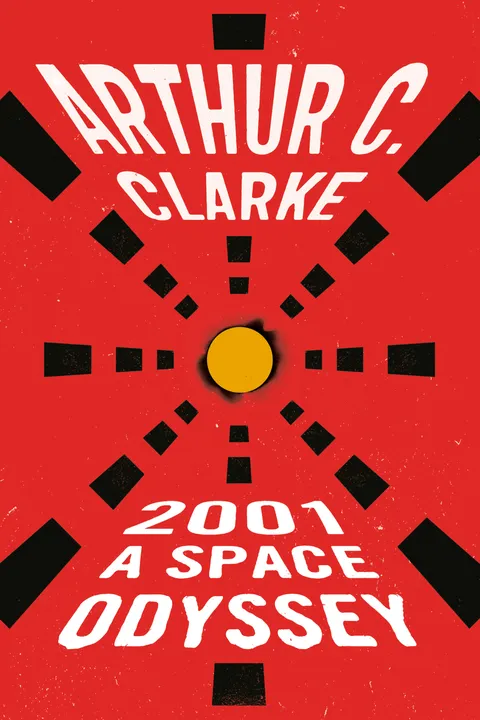
2001: A Space Odyssey
Report an issue
Tell us what's wrong and we'll take a look.
Thanks – we got it. We'll review and follow up if needed.

The classic science fiction novel that captures and expands on the vision of Stanley Kubrick’s immortal film—and changed the way we look at the stars and ourselves.
From the savannas of Africa at the dawn of mankind to the rings of Saturn as man ventures to the outer rim of our solar system, 2001: A Space Odyssey is a journey unlike any other.
This allegory about humanity’s exploration of the universe—and the universe’s reaction to humanity—is a hallmark achievement in storytelling that follows the crew of the spacecraft Discovery as they embark on a mission to Saturn. Their vessel is controlled by HAL 9000, an artificially intelligent supercomputer capable of the highest level of cognitive functioning that rivals—and perhaps threatens—the human mind.
Grappling with space exploration, the perils of technology, and the limits of human power, 2001: A Space Odyssey continues to be an enduring classic of cinematic scope.
Arthur C. Clarke
Born in Somerset in 1917, Arthur C. Clarke has written over sixty books, among which are the science fiction classics ‘2001, A Space Odyssey’, ‘Childhood’s End’, ‘The City and the Stars’ and ‘Rendezvous With Rama’. He has won all the most prestigious science fiction trophies, and shared an Oscar nomination with Stanley Kubrick for the screenplay of the film of 2001. He was knighted in 1998. He passed away in March 2008.
More by Arthur C. Clarke


Why Readwise Books?
Readwise Books is an ebook & audiobook platform that automatically logs how much you and your friends read, making it fun and easy to read more. Learn more →