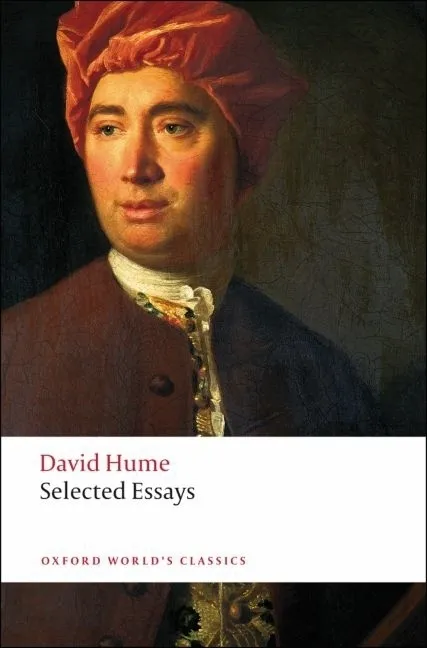
Selected Essays
Report an issue
Tell us what's wrong and we'll take a look.
Thanks – we got it. We'll review and follow up if needed.
As seen in these selections, Hume embraces a staggering range of social, cultural, political, demographic, and historical concerns, charting the state of civil society, manners, morals, and taste, and the development of political economy in the mid-eighteenth century. These essays represent not only those areas where Hume's arguments representative of his age, but also where he is strikingly innovative.
About the Series: For over 100 years Oxford World's Classics has made available the broadest spectrum of literature from around the globe. Each affordable volume reflects Oxford's commitment to scholarship, providing the most accurate text plus a wealth of other valuable features, including expert introductions by leading authorities, voluminous notes to clarify the text, up-to-date bibliographies for further study, and much more.
David Hume
David Hume was a Scottish philosopher, historian, economist, and essayist of the Enlightenment. After completing his studies in law at the University of Edinburgh, he distxtered that philosophy was his real interest. Hume challenged conventional ideas of causality and human understanding in his seminal philosophical work "A Treatise of Human Nature" (1739-1740), which served as the foundation for his empiricist and sceptical viewpoints. His collection of essays, "Essays Moral, Political, and Literary," which included subjects ranging from economics to aesthetics, further demonstrated his wide range of interests. Hume wrote the influential six-volume "History of England," which provides a history of English history from antiquity to the 17th century, in addition to his philosophical endeavours. It turned into a notable literary work even if it wasn't often historically correct. Known for his contributions to the Scottish Enlightenment, Hume's views on scepticism and empiricism affected other philosophers, such as Immanuel Kant. His writings are still studied for their influence on political theory, metaphysics, ethics, and epistemology even though they were first criticized.
More by David Hume

















Why Readwise Books?
Readwise Books is an ebook & audiobook platform that automatically logs how much you and your friends read, making it fun and easy to read more. Learn more →