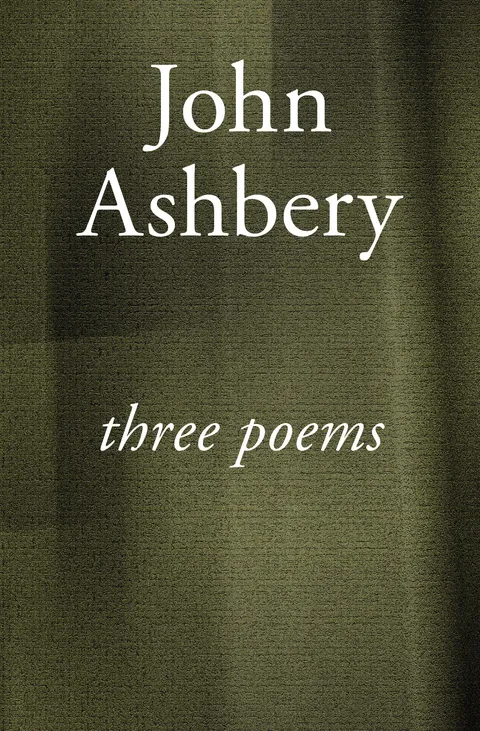
Three Poems
Report an issue
Tell us what's wrong and we'll take a look.
Thanks – we got it. We'll review and follow up if needed.
A provocative, challenging masterpiece by John Ashbery that set a new standard for the modern prose poem "The pathos and liveliness of ordinary human communication is poetry to me," John Ashbery has said of this controversial work, a collection of three long prose poems originally published in 1972, adding, "Three Poems tries to stay close to the way we talk and think without expecting what we say to be recorded or remembered." The effect of these prose poems is at once deeply familiar and startlingly new, something like encountering a collage made of lines clipped from every page of a beloved book—or, as Ashbery has also said of this work, like flipping through television channels and hearing an unwritten, unscriptable story told through unexpected combinations of voices, settings, and scenes. In Three Poems, Ashbery reframes prose poetry as an experience that invites the reader in through an infinite multitude of doorways, and reveals a common language made uncommonly real.
John Ashbery
John Ashbery's latest book of poems is Quick Question. From 1960 to 1965, he was the International Herald Tribune art critic and ArtNews Paris correspondent. France has named him Chevalier des Arts et des Lettres and Officier of the Légion d'Honneur. He has received a National Book Foundation Medal for Distinguished Contribution to American Letters, and President Obama awarded him a National Humanities Medal. Rosanne Wasserman and Eugene Richie's latest poetry book is Psyche and Amor. They have edited Ashbery's essays in Other Traditions and in Selected Prose, as well as his translations of Pierre Martory. She teaches at the U.S. Merchant Marine Academy; he is the director of writing at Pace University.
More by John Ashbery










Why Readwise Books?
Readwise Books is an ebook & audiobook platform that automatically logs how much you and your friends read, making it fun and easy to read more. Learn more →