Report an issue
Tell us what's wrong and we'll take a look.
Thanks – we got it. We'll review and follow up if needed.
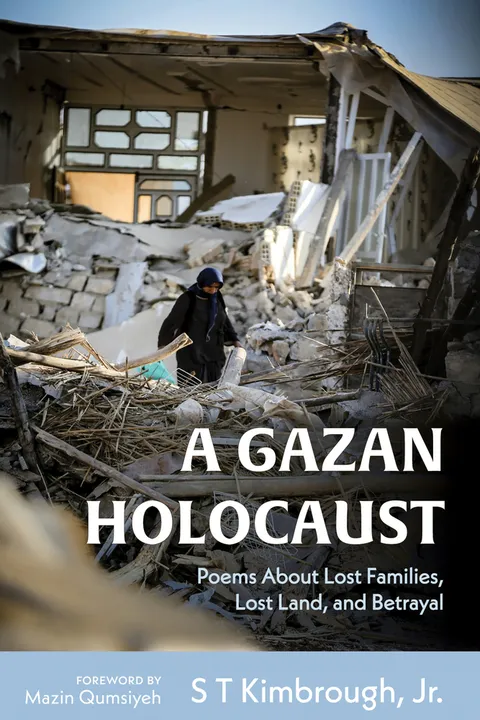
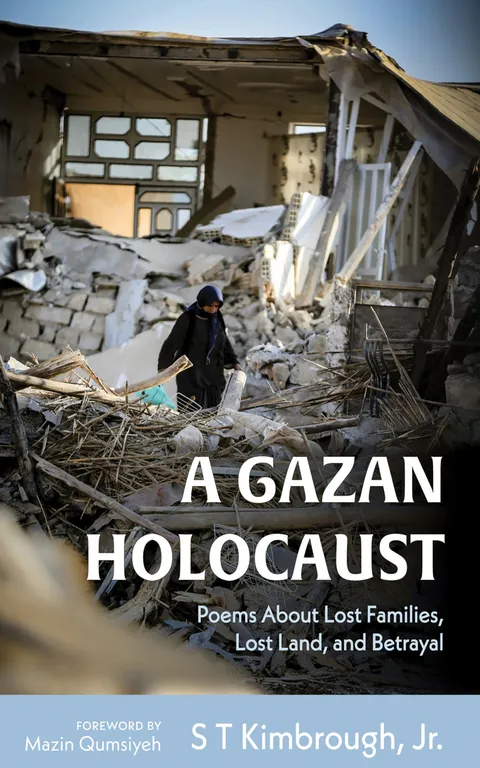
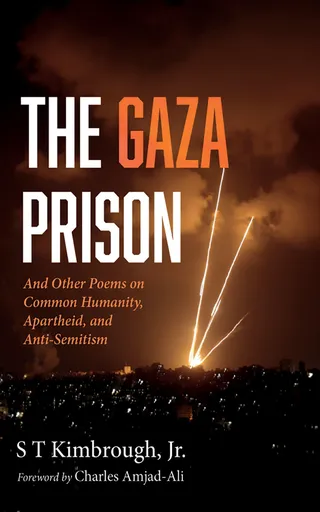
One generally speaks of the Holocaust as referring to the Nazis’ “final solution” during World War II to eliminate the Jewish population of Europe. However, the word generally is defined in dictionaries today as follows: “destruction or slaughter on a mass scale.” The poems in this book are inspired by the State of Israel’s goal and determination to eliminate the Palestinian population of Gaza (ca. 2.2 million Palestinians, before the current war) by any means: destruction, starvation, or with weapons. Therefore, this book is titled A Gazan Holocaust.
Surely there is no simplistic answer for Israel and the Palestinians, including the blunt, misdirected concept of a divinity who has authorized, by any means possible, the killing and dispossession of peoples to award specific territory and its governance to some, to the exclusion of all others. What a tragic misuse of the message of the biblical prophets.
These poems raise a persistent question regarding injustice to and murder of women and children: Is there no remnant of humaneness left which shows that humans know the meaning of grace and kindness? Where can Jews, Muslims, and Christians find release from the tragedy of war and its innumerable losses? In the Holy Land?
S T Kimbrough
Dr. Steven Kimbrough, Jr., is a Research Fellow of the Center for Studies in the Wesleyan Tradition of the Duke Divinity School. He is also a member of the Center of Theological Inquiry in Princeton, NJ, and an internationally known scholar and musician who has devoted years to the study of Charles Wesley's verse. He was a Consultant to the Hymnal Revision Committee of The United Methodist Church. 21 Susanna Drive, Durham, NC 27705
More by S T Kimbrough



Why Readwise Books?
Readwise Books is an ebook & audiobook platform that automatically logs how much you and your friends read, making it fun and easy to read more. Learn more →