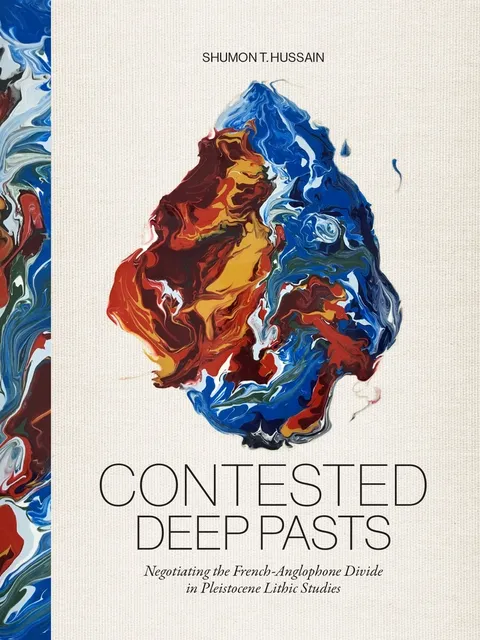
Contested Deep Pasts
Negotiating the French-Anglophone Divide in Pleistocene Lithic Studies
Report an issue
Tell us what's wrong and we'll take a look.
Thanks – we got it. We'll review and follow up if needed.
French-Anglophone research conflicts in Palaeolithic archaeology shape opposing cognitive frameworks for interpreting lithic evidence.
This book offers the first in-depth analysis of French-Anglophone research conflicts in Palaeolithic archaeology. By carefully examining a range of case studies and discursive contexts, the author shows that French and Anglophone approaches to the lithic evidence are anchored in opposing cognitive frameworks.
The mainstays of this division are outlined by drawing on the work of American philosopher Stephen C. Pepper, who captured the totality of credible Western thought in terms of four equitable world hypotheses. The book demonstrates that French lithic research gravitates towards contextualistic and organicistic modes of inquiry, whereas Anglophone approaches tend to rely on formistic and mechanistic modes of inquiry. The implications of this difficult condition for mutual understanding and critical practice are explored and it is argued that the French-Anglophone divide can only be satisfactorily navigated if practitioners endorse scientific pluralism, cultivate a more reflexive stance towards their own work, and begin to seriously take into consideration the strengths and shortcomings of different cognitive frameworks.
While the book seeks to clarify the methodological, theoretical and epistemological landscape of Palaeolithic stone artefact analysis and will therefore be of a key source for lithic specialists, it may also be of interest for a broader readership from Science and Technology Studies (STS), the history and philosophy of science, and nascent interdisciplinary science studies.
Shumon T Hussain
Shumon T. Hussain is a transdisciplinary archaeologist with a research focus on Late Pleistocene and Early Holocene foragers, especially their stone artefact technologies and animal relationships. He is broadly interested in theoretical innovation and synthesis beyond archaeology as a disciplinary specialism, to better integrate data and perspectives across the humanities and sciences vis-à-vis question of the human deep past, and the epistemology and practice of science. He is currently based at the University of Cologne, Germany, where he is a senior researcher and lecturer at the newly established research hub MESH - Multidisciplinary Environmental Studies in the Humanities.


Why Readwise Books?
Readwise Books is an ebook & audiobook platform that automatically logs how much you and your friends read, making it fun and easy to read more. Learn more →