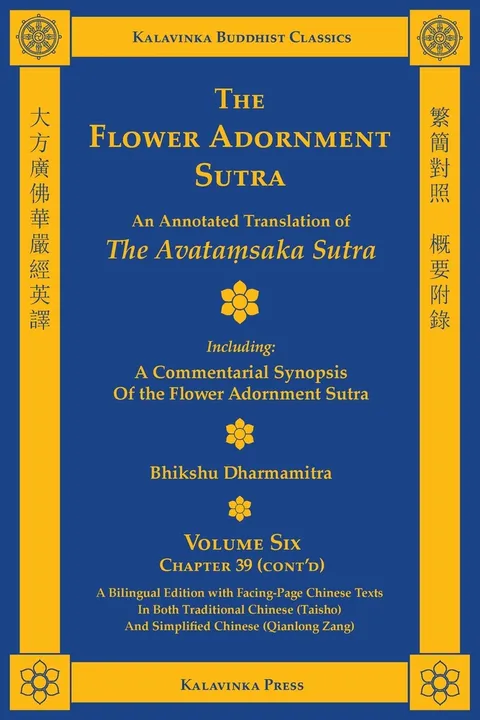
The Flower Adornment Sutra (Bilingual) - Volume Six
An Annotated Translation of the Avataṃsaka Sutra with "A Commentarial Synopsis of the Flower Adornment Sutra"
Report an issue
Tell us what's wrong and we'll take a look.
Thanks – we got it. We'll review and follow up if needed.
The Flower Adornment Sutra is Bhikshu Dharmamitra's extensively annotated original translation of the Mahāvaipulya Buddha Avataṃsaka Sūtra or "The Great Expansive Buddha's Flower Adornment Sutra" which he has rendered from Tripiṭaka Master Śikṣānanda's circa 699 ce Sanskrit-to-Chinese 80-fascicle translation as the "Da Fangguang Fo Huayan Jing" (大方廣佛華嚴經 / Taisho Vol. 10, no. 279). Appended here as the conclusion to Chapter 39 is Dharmamitra's English translation of Tripiṭaka Master Prajñā's translation into Chinese of "The Conduct and Vows of Samantabhadra" which is traditionally included as the conclusion of Chinese language editions of this sutra. Altogether, this sutra consists of 39 chapters that introduce an interpenetrating, infinitely expansive, and majestically grand multiverse of countless buddha worlds while explaining in great detail the cultivation of the bodhisattva path to buddhahood, most notably the ten highest levels of bodhisattva practice known as "the ten bodhisattva grounds." To date, this is the first and only complete English translation of the Avataṃsaka Sutra. This special bilingual edition (English / Chinese) includes the facing-page simplified and traditional Chinese scripts to facilitate close study by academic buddhologists, students in Buddhist universities, and Buddhists in Taiwan, Hong Kong, Mainland China, and the West.
Bhikshu Dharmamitra
Translated by
Bhikshu Dharmamitra (ordination name "Heng Shou" - 釋恆授) is a Chinese-tradition translator-monk and one of the earliest American disciples (since 1968) of the late Guiyang Ch'an patriarch, Dharmateacher, and pioneer of Buddhism in the West, the Venerable Master Hsuan Hua (宣化上人). He has a total of 34 years in robes during two periods as a monastic (1969‒1975 & 1991 to the present). Dharmamitra's principal educational foundations as a translator of Sino-Buddhist Classical Chinese lie in four years of intensive monastic training and Chinese-language study of classic Mahāyānatexts in a small-group setting under Master Hsuan Hua (1968-1972), undergraduate Chinese language study at Portland State University, a year of intensive one-on-one Classical Chinese study at the Fu Jen University Language Center near Taipei, two years of course work at the University of Washington's Department of Asian Languages and Literature (1988-90), and an additional three years of auditing graduate courses and seminars in Classical Chinese readings, againat UW's Department of Asian Languages and Literature.Since taking robes again under Master Hua in 1991, Dharmamitra has devoted his energies primarily to study and translation of classic Mahāyāna texts with a special interest in works by Ārya Nāgārjuna and related authors. To date, he has translated more than fifteen important texts comprising approximately 150 fascicles, including most recently the 80-fascicle Avataṃsaka Sūtra (the"Flower Adornment Sutra"), Nāgārjuna's 17-fascicle Daśabhūmika Vibhāśa ("Treatise on the Ten Grounds"), and the Daśabhūmika Sūtra (the "Ten Grounds Sutra"), all of which are current or upcoming Kalavinka Press publications.
Tripitaka Master Śikṣānanda
Translated by
Tripitaka Master Śikṣānanda (652-710 ce) was a major translator of Buddhist texts into Chinese during the Tang Dynasty. This monk from Khotan is most remembered for his 699 ce Sanskrit-to-Chinese translation of this 80-fascicle edition of the Avataṃsaka Sutra.
Tripitaka Master Prajñā
Translated by
Tripitaka Master Prajñā (734-? ce) was a Buddhist monk from Kapisa who contributed several important Chinese translations of Sanskrit sutras during the Tang Dynasty, including the 40-fascicle edition of the Avataṃsaka Sutra comprising only a single chapter titled "Entering the Inconceivable Realm of Liberation of the Conduct and Vows of Samantabhadra."


Why Readwise Books?
Readwise Books is an ebook & audiobook platform that automatically logs how much you and your friends read, making it fun and easy to read more. Learn more →