Report an issue
Tell us what's wrong and we'll take a look.
Thanks – we got it. We'll review and follow up if needed.
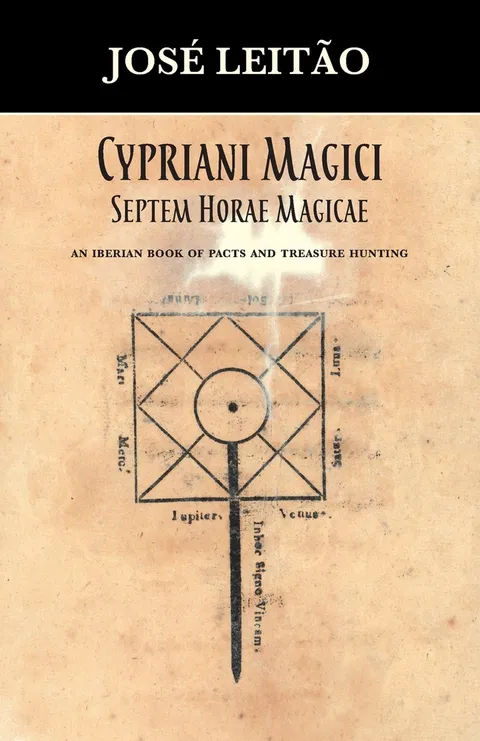
Transcribed, translated and published here for the first time, accompanied by an in-depth introduction and historical and contextual analysis by José Leitão, this short text, besides being a treasure hunting book, is a complex object, offering instructions and recipes for consecration incenses and various magical implements, explicitly non-Solomonic methods for the performance of a pact with the spirit Lucifuge Rofocale, and suggesting his local relationship with the Iberian folk figures of the mouras encantadas.
The history of the Iberian Books of Saint Cyprian is an eternally unfinished one. While these books are not as much of a mystery as they once were, they are a form of literature still steeped in cultural and academic obscurity. When researching such books, the finding of one word mentioned in a time and place where it was not supposed to have been mentioned, can cast down our entire edifice of academic proposals, considerations, and theories on their origin and evolution. Books of Saint Cyprian, in their full extent, exist in a haunted history, obfuscated by culture and by law; as tangible objects whose content rests in intangibility, and self-contained collections of information reaching beyond themselves. Folk tales and urban myths will tell us of devilish Books of Saint Cyprian as more than repositories of information, but as active participants in the downfall of their unwise users. To investigate these books and not become lost in their riddles requires one to pay no mind to their misleading titles, seductive self-fabricated glamour and convoluted inner-histories and sometimes even the words of fellow researchers.
It was thus that, in 1888 the Portuguese philologist, ethnographer, and pedagogue Francisco Adolfo Coelho published a paragraph from a purported 'authentic' Book of Saint Cyprian he had seen, in passing, in the hands of one of his acquaintances - an old and weathered pre-printing-press thing, written in a garbled language and containing diabolical invocations and gruesome recipes, as if something taken out of a legend; a book he claimed was called the Cypriani Magici Septem Horae Magicae. Resting on nothing but his word, news of this text was shrugged off by any and all who investigated the Cyprian books for the next one hundred and forty years as an odd fluke, an impossible report or a mistake of some sort. This, until the words Septem Horae Magicae were unexpectedly found on a lost index card of the Portuguese National Library in 2021.
The Cypriani Magici Septem Horae Magicae presents itself as a rare window into the short but intense period when the Books of Saint Cyprian found themselves between manuscript and print, between folk and learned, and Iberia and Europe. It is a cultural treasure, an irreverent magic text and it poses more questions than it answers.
José Leitão
José Leitão is a former experimental physicist currently studying Portuguese magic and religion in the records of the Portuguese Inquisition as a PhD student at the University of Coimbra. Besides his Physics PhD (defended in 2014), he also holds a Master's degree in Religious Studies, with a major in Western Esotericism, from the University of Amsterdam (finished in 2016).His current research interest is the mapping of learned Magic in Portugal using the records of the Portuguese Inquisition. This includes both the study of the production of autochthonous magic books or the circulation of European texts and Grimoires in Portugal. As a secondary topic, he also researches expressions of folk magic and religion in this same database, particularly those focusing on the figure of St. Cyprian of Antioch.
More by José Leitão


Why Readwise Books?
Readwise Books is an ebook & audiobook platform that automatically logs how much you and your friends read, making it fun and easy to read more. Learn more →