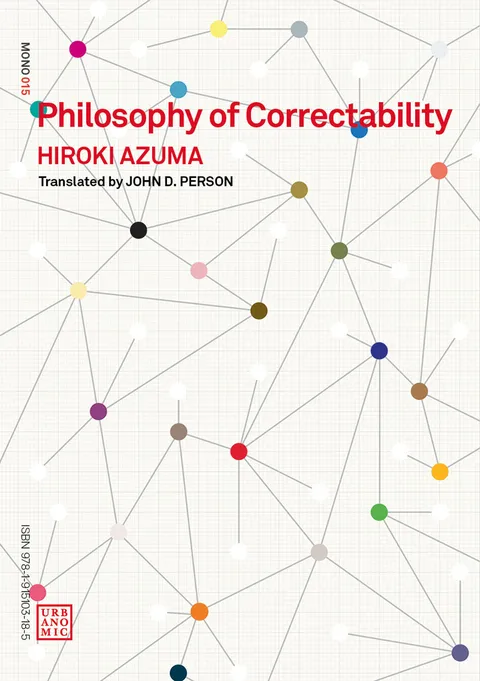
Philosophy of Correctability
Report an issue
Tell us what's wrong and we'll take a look.
Thanks – we got it. We'll review and follow up if needed.
A profound rethinking of the political categories of openness and closedness.
In a new work building upon his Philosophy of the Tourist, Hiroki Azuma reconsiders the connection between the figure of the tourist and that of the family. Setting out from the reevaluation of the family as a figure of containment following the COVID-19 pandemic, in this exploration of the inside and outside of community, Azuma questions the shifting values of openness and security, challenging the distinction between the openness of civil society and the closedness of the family, which he deciphers as an artefact of a Western philosophical standpoint in which polis is opposed to oikos.
Via Wittgenstein’s notion of family resemblance and Kripke’s interpretation of language games, Azuma develops a new concept of the family as a closed unit that is paradoxically open to drastic transformations of its own rules of inclusion. The tourist, an anomaloous agent that escapes Carl Schmitt’s opposition between friend and enemy, can then be reinterpreted as a familial figure.
In this subtle rethinking of some of the most fundamental categories of modern political economy, the topology of the open society is reconfigured beyond the opposition between conservatism and liberalism: through close readings of Rorty and Arendt, Azuma sketches out a new vision of an open polis supported by the transformative sustainability of the oikos.
Hiroki Azuma
Hiroki Azuma is codirector of the Academy of Humanities in the Center for the Study of World Civilizations at the Tokyo Institute of Technology. A leading cultural critic in Japan, he is the author of seven books, including Ontological, Postal, which won the 2000 Suntory Literary Prize.
More by Hiroki Azuma





Why Readwise Books?
Readwise Books is an ebook & audiobook platform that automatically logs how much you and your friends read, making it fun and easy to read more. Learn more →