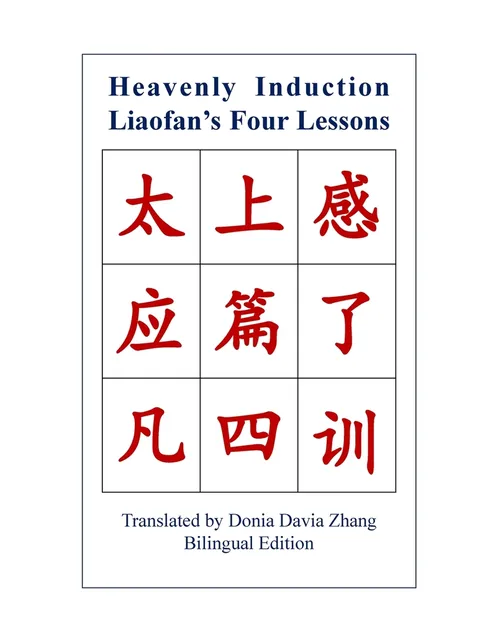
Heavenly Induction, Liaofan's Four Lessons
Ebook
Unavailable
Audiobook
Unavailable
Hardback
Unavailable
Chinese Culture PublishingISBN 9781778286148
Translated by Donia Zhang
Report issue
Report an issue
Tell us what's wrong and we'll take a look.
Thanks – we got it. We'll review and follow up if needed.
Taishang Ganying Pian, translated into English as Heavenly Induction, is a Daoist scripture from the Song dynasty (960-1279) to persuade people to always obey moral norms, stop evil, cultivate kindness, and benefit oneself and others. The chapter places special emphasis on the "Law of Responsibility," and is reputed as "The first Chinese book on kindness since ancient times." The first chapter sets the stage and acts as the guiding principle for the following four chapters. Liaofan Si Xun, or Liaofan's Four Lessons, was written by Yuan Liaofan (1533‒1606) during China's Ming dynasty (1368‒1644), with the hope of teaching his son, Yuan Tianqi, to understand true destiny and practice good deeds: "Do good even if it is a small good deed," and "do not do evil even if it is a small evil act." In this way, one can change their destiny. Through his life experience, Yuan Liaofan provided living proof of the benefits of practicing good deeds and cultivating virtue and humility. This bilingual edition with original Chinese texts aims to help Western readers learn the Chinese language, while the English translation hope to aid Westerners better understand the deeper meanings of these lessons.


Why Readwise Books?
Readwise Books is an ebook & audiobook platform that automatically logs how much you and your friends read, making it fun and easy to read more. Learn more →