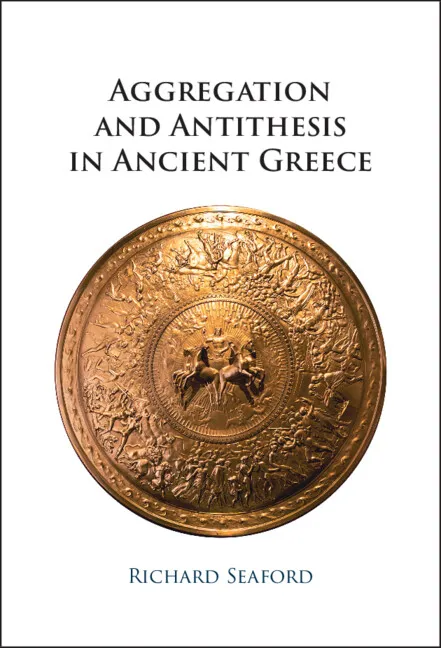
Aggregation and Antithesis in Ancient Greece
Report an issue
Tell us what's wrong and we'll take a look.
Thanks – we got it. We'll review and follow up if needed.
What is the relationship between forms of thought in literature, philosophy and visual art in ancient Greece, and how are these forms related to their socio-political and economic context? This is the question raised by Richard Seaford in his final book. His answer is framed in terms of the relationship between aggregation and antithesis. In Greece between the eight and fourth centuries BCE, Seaford traces a progressive and complex shift from aggregation to antithesis in literature, philosophy and visual art, and correlates this with the shift from a pre-monetary and pre-polis society to a monetised polis. In the Platonic metaphysics of being, he identifies a further move, the negation of antithesis, which he links with the non-circulating possession of money. In this characteristically ambitious and challenging study, Richard Seaford extends his socio-economic analysis of Greek culture to visual art and includes contrasts with Near Eastern society and art.
Richard Seaford
Richard Seaford is Emeritus Professor of Ancient Greek at the University of Exeter. His books include commentaries on Euripides' Cyclops and on Euripides' Bacchae, as well as Reciprocity and Ritual (1994), Dionysos (2006), Money and the Early Greek Mind (Cambridge, 2004), and Cosmology and the Polis (Cambridge, 2012). A volume of his selected papers has recently been published entitled Tragedy, Ritual and Money in Ancient Greece (Cambridge, 2018).
More by Richard Seaford


Why Readwise Books?
Readwise Books is an ebook & audiobook platform that automatically logs how much you and your friends read, making it fun and easy to read more. Learn more →