Report an issue
Tell us what's wrong and we'll take a look.
Thanks – we got it. We'll review and follow up if needed.
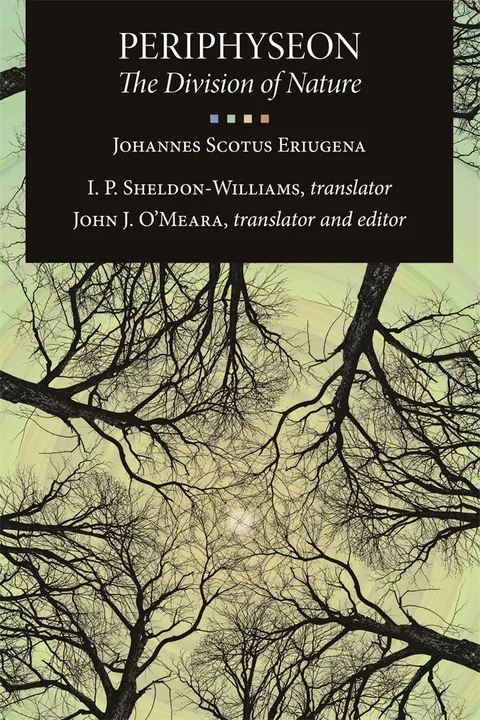
Called the "final achievement" of ancient philosophy, Periphyseon draws on knowledge of both the Greek and Latin Christian theological traditions, remarkable in the Carolingian world. It presents a Neoplatonic cosmology in the form of a catechetical dialogue between master and pupil covering the fourfold division of nature, in which all of reality is involved in a procession from and return to the One.
Periphyseon was written by Johannes Scotus Eriugena (ca. 810-ca. 877), an Irish monk, translator, and philosopher. By 851, he was at the West Frankish court of Charles the Bald, where he would remain for the rest of his life at the palace school. Although Eriugena had followers in his time and later among the mystics--the School of St. Victor, Eckhart, Tauler, Ruysbroeck, and the German mystics, and Nicholas of Cusa and his professed disciple Giordano Bruno--many in the West did not welcome his ideas, and his work was condemned by Honorius III in 1225.
I P Sheldon-Williams
Translated by
I. P. Sheldon-Williams was a scholar of the Christian Neoplatonic tradition and was editor of the critical edition of the Periphyseon in the Scriptores Latini Hiberniae series.


Why Readwise Books?
Readwise Books is an ebook & audiobook platform that automatically logs how much you and your friends read, making it fun and easy to read more. Learn more →