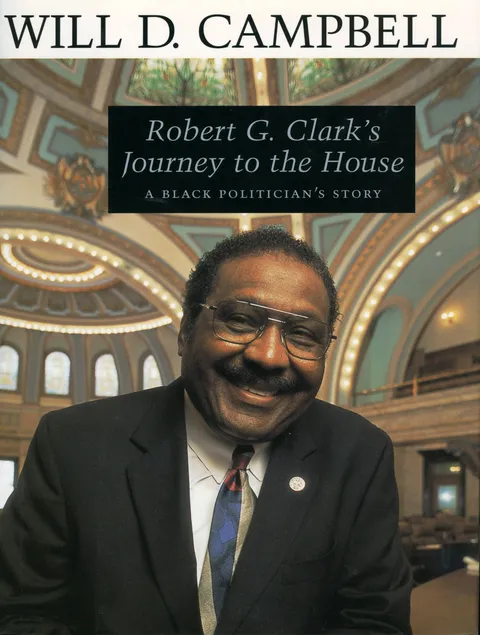
Robert G. Clark's Journey to the House
Report an issue
Tell us what's wrong and we'll take a look.
Thanks – we got it. We'll review and follow up if needed.
This biographical profile written by one of the South's most notable authors traces the life of Robert George Clark Jr. (1928-2025) from his Jim Crow boyhood in Ebenezer, Mississippi, through his notable career as the first Black Mississippian since Reconstruction to be elected to the Mississippi House of Representatives.
In this compelling book Will D. Campbell fuses Clark's family history with his political career and tells of Clark's struggle with segregationists, his powerful influence in the passing of the state's 1982 Education Reform Bill, and the continued influence of his work on Mississippi politics and culture.
Based on interviews, research, and primary sources, Campbell's book is an evocative, fascinating, and elegantly written portrait of a man who shaped the culture of contemporary Mississippi.
In details of Clark's days as a student at Jackson State University, Campbell's narrative depicts Clark both as a strong individual and as a symbol of African American civil rights activism. As he follows Clark's progress as a politician, educator, and civil rights advocate, he showcases a history of race relations and racial politics in Mississippi during the state's most turbulent era. In this steamy cauldron, however, Campbell never loses sight of Clark's singular life and notable accomplishments.
Robert G. Clark's Journey to the House unites one of Mississippi's foremost citizens of the twentieth century and one of the state's most notable literary voices. During the civil rights struggle, the lives of Clark and Campbell were in interplay. This striking book, a valuable addition to the ever-growing documentary literature of the civil rights movement, shows that their lives and philosophies continued to converge.
Will D Campbell
Will D. Campbell was a Baptist preacher in Taylor, Louisiana, for two years before taking the position of Director of Religious Life at the University of Mississippi from 1954 to 1956. Forced to leave the university because of his ardent Civil Rights participation, Campbell served on the National Council of Churches as a race relations consultant. Campbell worked closely with the Rev. Martin Luther King Jr., John Lewis, and Andrew Young toward bettering race relations. Campbell's Brother to a Dragonfly earned him the Lillian Smith Prize, the Christopher Award, and a National Book Award nomination. The Glad River won a first-prize award from the Friends of American Writers in 1982. His works have also won a Lyndhurst Prize and an Alex Haley Award.
More by Will D Campbell





Why Readwise Books?
Readwise Books is an ebook & audiobook platform that automatically logs how much you and your friends read, making it fun and easy to read more. Learn more →