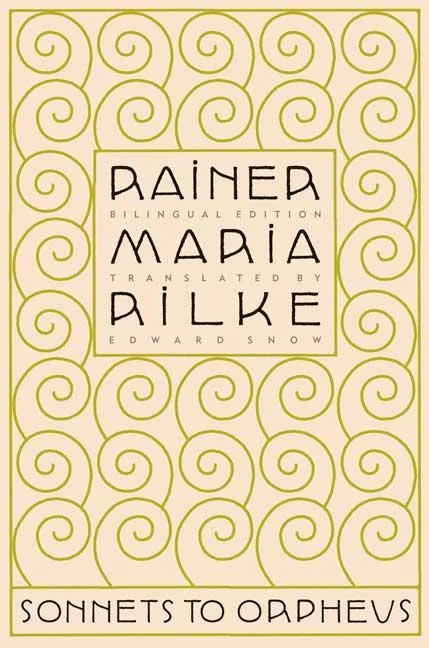
Sonnets to Orpheus
Report an issue
Tell us what's wrong and we'll take a look.
Thanks – we got it. We'll review and follow up if needed.
Breathing, you invisible poem!
World-space in pure continuous interchange
with my own being. Equipose
in which I rhythmically transpire.
Written only four years before Rilke's death, this sequence of sonnets, varied in form yet consistently structured, stands as the poet's final masterwork. In these meditations on the constant flux of our world and the ephemerality of experience, Rilke envisions death not only as one among many of life's transformations but also as an ideally receptive state of being. Because Orpheus has visited the realm of death and returned to the living, his lyre, a unifying presence in these poems, is an emblem of fluidity and musical transcendence. And Eurydice, condemned to Hades as a result of Orpheus's backward glance, becomes in Rilke's universe a mythical figure of consolation and hope.
Edward Snow, in his translations of New Poems, The Book of Images, Uncollected Poems, and Duino Elegies, has emerged as Rilke's most able English-language interpreter. Adhering faithfully to the intent of Rilke's German while constructing nuanced, colloquial poems in English, Snow's Sonnets to Orpheus should serve as the authoritative translation for years to come.
Rainer Maria Rilke
Rainer Maria Rilke (1875-1926), the author of the Duino Elegies and Sonnets to Orpheus, was one of the greatest poets of the German language.
More by Rainer Maria Rilke

















Why Readwise Books?
Readwise Books is an ebook & audiobook platform that automatically logs how much you and your friends read, making it fun and easy to read more. Learn more →