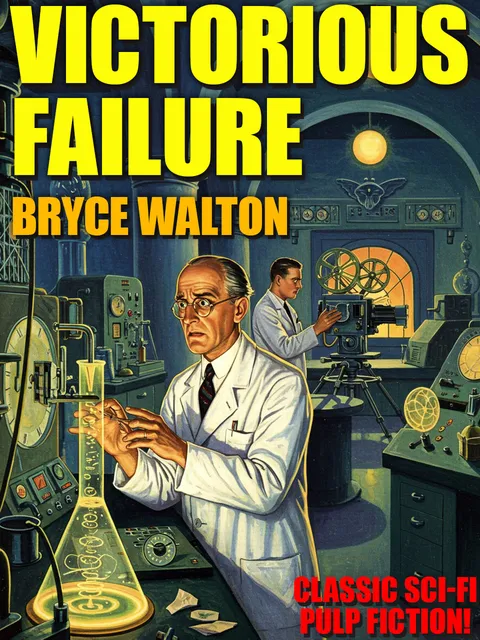
Victorious Failure
Report an issue
Tell us what's wrong and we'll take a look.
Thanks – we got it. We'll review and follow up if needed.
When biochemist Professor H. Klauson develops a method to grant humanity immortality, strange forces seem determined to prevent his success. Each time he approaches the final experiment, his mind collapses into unconsciousness. His wife Lin begs him to abandon the research, sensing an otherworldly presence working against them. Despite support from the World Science Presidium's medical staff, no logical explanation emerges for his mysterious breakdowns.
As Klauson pushes forward with his life's work, he discovers his trusted assistant Larry Verrill harbors an extraordinary secret. Verrill is actually Varro, a fourth-dimensional being from humanity's evolutionary future who has traveled through time to prevent the professor's discovery. The revelation unfolds a cosmic paradox: if humans achieve immortality, they will cease evolving, preventing the emergence of the advanced beings who sent Varro back in time. In this intricate web of cause and effect spanning multiple dimensions, Klauson must confront the ultimate question of whether humanity's greatest gift might also be its greatest curse.
Bryce Walton
Bryce Walton was an American author and screenwriter, known for his contributions to the science fiction genre, particularly during the mid-20th century. His work spans both short stories and novels, with a focus on suspense, action, and speculative themes. His writing explored a wide range of other themes, including the consequences of technological advancement, interplanetary conflict, rebellion, and the moral complexities of human nature. Walton's narratives typically centered on ordinary individuals caught in extraordinary situations, often dealing with political intrigue, alien encounters, and the ethical dilemmas of survival in dystopian settings. His stories, such as Design for Doomsday and Savage Galahad, showcase his ability to create high-stakes, action-driven plots while still addressing deep philosophical and social questions. His works often included philosophical reflections on the nature of freedom, the costs of progress, and the role of individual choice in a rapidly changing world. Walton's contribution to the genre remains significant for its exploration of complex moral and societal questions through gripping, thought-provoking narratives. His stories reflect the anxieties and possibilities of the mid-20th century, making them resonate with readers interested in the intersection of technology, humanity, and the unknown.
More by Bryce Walton



Why Readwise Books?
Readwise Books is an ebook & audiobook platform that automatically logs how much you and your friends read, making it fun and easy to read more. Learn more →