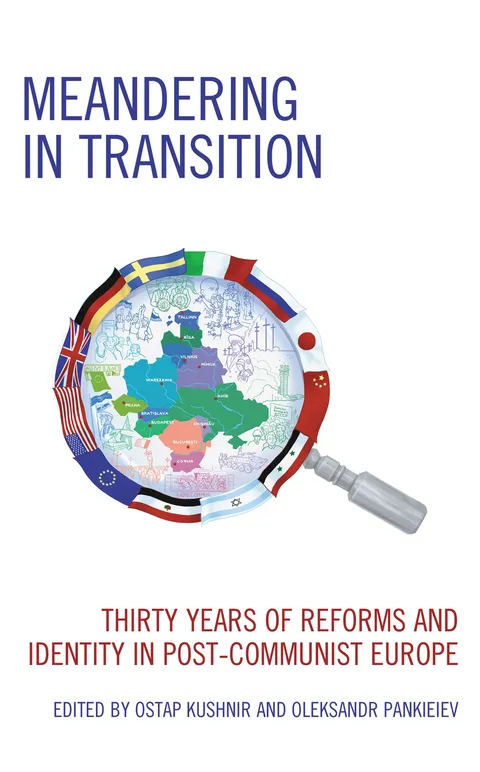
Meandering in Transition
Thirty Years of Reforms and Identity in Post-Communist Europe
Report an issue
Tell us what's wrong and we'll take a look.
Thanks – we got it. We'll review and follow up if needed.
This edited collection addresses the dynamics of the post-Communist transition in Central Eastern Europe. Its contributors present a detailed analysis of the events unfolding during the last three decades in the region, focusing in particular on identity-building processes and reforms in Belarus, Bulgaria, Czechia, Estonia, Hungary, Latvia, Lithuania, Moldova, Poland, Romania, Slovakia, and Ukraine.
The contributors outline reasons why some of these states accomplished a decisive break with the Communist past and became members of European and transatlantic structures, while some opted for pseudo-transition and fostered hybrid political regimes, jeopardizing their genuine integration with the West. A group of states which decided to preserve their Communist legacy is also explained.
The collection describes and scrutinizes the formation of geopolitical affiliations and the evolution of discourses of belonging. It also traces the fluctuating dynamics of national decision-making and institution-building, as many of the post-Communist states reconsider and re-elaborate their initial ideas and visions of Europe today.
Finally, the collection brings to light the rapidly changing perceptions of the region by the major global actors—the European Union, People’s Republic of China, Russian Federation, and others.
Ostap Kushnir
Ostap Kushnir is assistant professor at Lazarski University (Poland) and a lecturer with Coventry University programmes (UK)
Oleksandr Pankieiev
Oleksandr Pankieiev is research coordinator and Editor-in-Chief of the Forum for Ukrainian Studies at the Canadian Institute of Ukrainian Studies, University of Alberta.


Why Readwise Books?
Readwise Books is an ebook & audiobook platform that automatically logs how much you and your friends read, making it fun and easy to read more. Learn more →