Mcteague
Report an issue
Tell us what's wrong and we'll take a look.
Thanks – we got it. We'll review and follow up if needed.
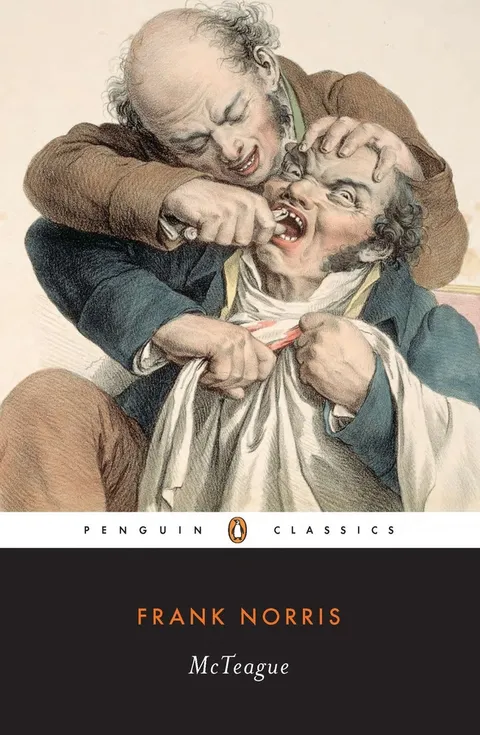

Newly-married, McTeague and Trina Sieppe appear to have a bright future, especially in light of Trina’s $5,000 lottery win. But when McTeague is barred from practicing dentistry, and Trina’s money-hoarding becomes pathological, the couple descends into poverty with stunning rapidity and far-reaching consequences.
Frank Norris’s 1899 novel explores the impact of jealousy and greed on an otherwise typical relationship. McTeague has been adapted twice for film, including the 1924 film Greed, directed by acclaimed auteur Erich von Stroheim.
HarperPerennial Classics brings great works of literature to life in digital format, upholding the highest standards in ebook production and celebrating reading in all its forms. Look for more titles in the HarperPerennial Classics collection to build your digital library.
Frank Norris
Frank Norris (1870-1902) was an American novelist and journalist associated with literary naturalism. His works include McTeague, The Octopus, The Pit, and Moran of the Lady Letty.The conditions of the writer's period are important to an understanding of the work. Questions about the individual and society, including the roles of education, work, belief, and public institutions, repeatedly enter the literature and intellectual debates of the era. The historical setting should not be confused with a modern retelling: the language and assumptions of these works belong to their original moment.Norris studied art in Paris and attended the University of California and Harvard before working as a journalist. His interest in the naturalist fiction of Émile Zola encouraged him to dramatize the effects of economic institutions and environment on individuals. McTeague portrayed ambition and deterioration in San Francisco, while The Octopus examined the conflict between California wheat growers and railroad power. The Pit was planned as the second part of The Epic of the Wheat, a trilogy that would follow grain from production through speculation to consumption. Set against Chicago's grain trade, it combines economic pressures with domestic and psychological tensions. The novel was published after Norris's death in 1902; the projected final volume, The Wolf, was never completed. Norris's abbreviated career nevertheless helped shape American naturalist fiction through its energetic narrative style and its ambition to portray the large systems affecting ordinary lives.For readers of The Pit, this biographical and publication context matters because the book addresses questions that were visible to its first audience but may be less familiar today. Understanding the author's working circumstances, intended genre, and intellectual environment can clarify the choices made in the text without treating its incidents as literal autobiography.In The Pit, the writer turns to american naturalist novel to develop a particular subject. The posthumously published second part of Frank Norris's projected Epic of the Wheat. Its achievement is best understood in connection with the author's established body of writing and the literary conventions through which the subject is presented.Readers approaching this work today can appreciate its historical frame alongside its literary ambitions. Its treatment of character, perspective, society, or argument offers insight into the concerns that shaped its original audience. Where names, dates, or the original author's identity are uncertain, those details should be resolved through the edition and bibliographical record rather than supplied by conjecture.
More by Frank Norris


Why Readwise Books?
Readwise Books is an ebook & audiobook platform that automatically logs how much you and your friends read, making it fun and easy to read more. Learn more →