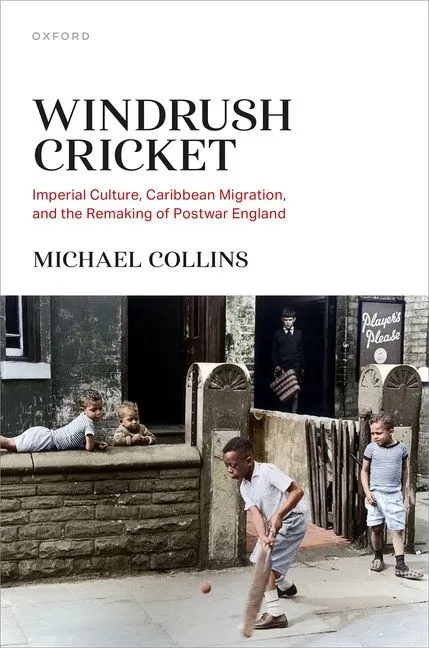
Windrush Cricket
Imperial Culture, Caribbean Migration, and the Remaking of Postwar England
Report an issue
Tell us what's wrong and we'll take a look.
Thanks – we got it. We'll review and follow up if needed.
Following the work of the great Trinidadian intellectual C. L. R. James, much has been written about the profound importance of cricket for the development of social and cultural life within the Anglophone Caribbean. And yet, from at least the 1930s, black West Indian cricketers were celebrated far beyond the Caribbean, in England and across empire. Cricket was in fact a major factor shaping imperial ideas about black people--how they looked and behaved, what their imagined characteristics and traits were--placing the West Indies, as the Caribbean islands were then known, within a racialised, hierarchical structure of cricket-loving peoples, alongside the colonies of white settlement: South Africa, New Zealand, Australia.
During World War II, black West Indians played prominent roles in the surprisingly large amount of cricket played in England, part of a wider propaganda effort to promote the idea of a multiracial empire, united in common cause against fascism. For post-Windrush arrivals after 1948, cricket was not just a peripheral pastime or a recreational footnote. Cricket was a cornerstone of black West Indian social and cultural life and self-empowerment in England, integral to the earliest creation of social and community groups and the development of support networks. Watching the West Indies international cricket team win on the field of play was just one part of the Windrush story. Through the late 1940s and into the 1950s, the growth of an extensive network of Windrush cricket teams and clubs, and, by the 1970s, the evolution of Caribbean cricket leagues and competitions, created a subtle and multifaceted sense of being a West Indian in England. In due course, the children of Windrush migrants would seek to play cricket for England, challenging the very notion of what it means to be English.
Interweaving extensive archival and oral history research into an engaging, often surprising narrative about empire and postwar Britain, Windrush Cricket challenges a range of orthodoxies, arguing that cricket constituted a foundational, yet almost entirely ignored aspect of the way in which Windrush migrants settled and made new lives in postwar England.
Michael Collins
Michael Collins was a pseudonym for Dennis Lynds (1924–2005), a renowned author of mystery fiction. Raised in New York City, he earned a Bronze Star and a Purple Heart during World War II, before returning to New York to become a magazine editor. He published his first book, a war novel called Combat Soldier, in 1962, before moving to California to write for television. Two years later Collins published the Edgar Award–winning Act of Fear (1967), which introduced his best-known character: the one-armed private detective Dan Fortune. The Fortune series would last for more than a dozen novels, spanning three decades, and is credited with marking a more politically aware era in private-eye fiction. Besides the Fortune novels, the incredibly prolific Collins wrote science fiction, literary fiction, and several other mystery series. He died in Santa Barbara in 2005.
More by Michael Collins











Why Readwise Books?
Readwise Books is an ebook & audiobook platform that automatically logs how much you and your friends read, making it fun and easy to read more. Learn more →