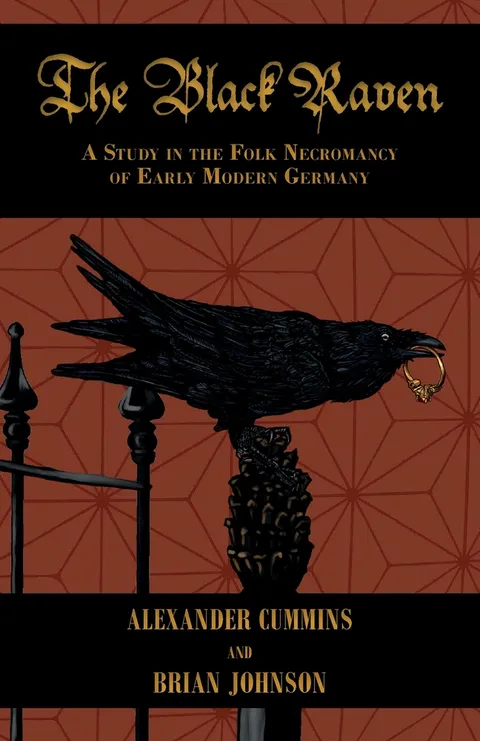
The Black Raven
A Study in the Folk Necromancy of Early Modern Germany
Report an issue
Tell us what's wrong and we'll take a look.
Thanks – we got it. We'll review and follow up if needed.
The Black Raven is a grimoire composed in German-speaking lands sometime in the late eighteenth or early nineteenth century. Appearing at first glance to be a typically eclectic assortment of conjurations and ritual directions, upon closer analysis this humble volume is revealed to comprise a cohesive toolkit for the treasure-hunting nigromancer: presenting conjurational means for both petitioning devilish lords of earthly riches and laying the ghosts who haunted their troves, as well as planetary spiritwork for best timing such endeavours.
Indeed, if the books they left behind are any indication, the recovery of hidden treasure was among the most ubiquitous pursuits of medieval and early modern magicians. Given the widespread assumption that such immured valuables were likely to be guarded by malevolent spirits, it stood to reason that the methods of ritual exorcism, with their protective invocations and banishing execrations, would be ideally suited to clearing the practitioners' path to wealth, perhaps even inducing the cooperation of those same spirits.
But the deceptions and diversions of infernal demons were not the only obstacle between such treasure hunters and a buried hoard; often the shade of its deceased owner also haunted the vicinity, trapped by the very riches which they had failed to divest in life. It was for this reason that grimoires such as the present nigromantic handbook, along with no few others of the Germanic "Faustian" genre, included protocols for liberating the restless dead from their earthly fetters in pursuit of liberating their property for the use of the living.
The text of the Black Raven is presented here in English translation for the first time, along with a transcription and facsimile of the original German manuscript. In addition, framing essays by Alexander Cummins and Brian Johnson place this conjurer's vade mecum within the context of early modern ghostlore, folk nigromancy, and the Faustian grimoiric corpus.
Alexander Cummins
Dan Harms is a librarian and author living in central New York. He has a masters in anthropology from the University at Buffalo, and a masters in library and information science from the University of Pittsburgh. His fascination with magical belief and practice has led him to research and publish a great deal in the areas of folklore, ritual magic, and their appearances in literature.His past works include The Cthulhu Mythos Encyclopedia, The Necronomicon Files (with John Wisdom Gonce), The Long-Lost Friend (editor), The Book of Oberon (with Joseph Peterson and Daniel Clark), William Dawson Bellhouse, Wax Images, Of Angels, Demons, and Spirits (with Daniel Clark), Balloonists, Alchemists, and Astrologers, and The Book of Four Wizards (with S. Aldarnay, forthcoming).His articles have been published in Abraxas, Folklore, Fortean Times, The Journal for the Academic Study of Magic, The Journal of Scholarly Communication, The Journal of the Western Mystery Tradition, Thanatos, and The Unspeakable Oath. He has spoken at Treadwell's in London, and at conferences at Oxford, Western Michigan University, and Waterloo University, among others. He is also an avid roleplaying gamer, and occasionally writes for publishers including Chaosium, Arc Dream, and others.
More by Alexander Cummins



Brian Johnson
Brian Johnson is passionate about raising up worshipers who take hold of their true identity and pursue intimacy with God above all else. Brian and his wife, Jenn, are advocates of living a lifestyle built on vulnerability, faithfulness, and connection to community. Brian and Jenn reside in Redding, California, with their four wonderful children, Haley, Téa, Braden, and Ryder Moses.
More by Brian Johnson











Why Readwise Books?
Readwise Books is an ebook & audiobook platform that automatically logs how much you and your friends read, making it fun and easy to read more. Learn more →