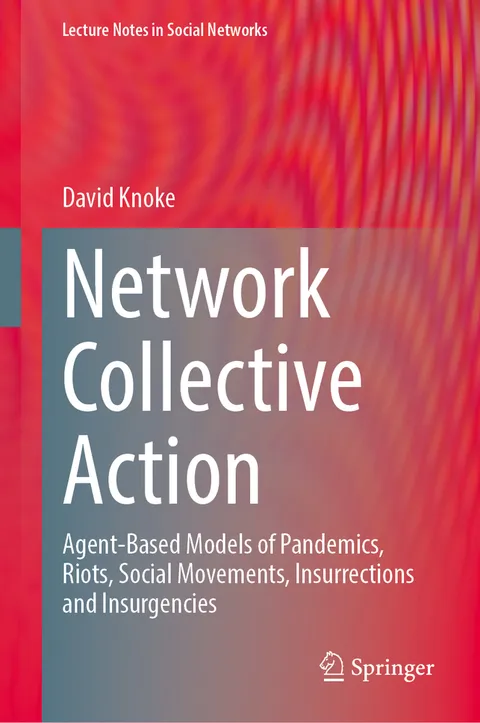
Network Collective Action
Agent-Based Models of Pandemics, Riots, Social Movements, Insurrections and Insurgencies
Report an issue
Tell us what's wrong and we'll take a look.
Thanks – we got it. We'll review and follow up if needed.
Collective action asks a fundamental question in social science: How do sets of actors
choose courses of action and work together to achieve desired outcomes, often in
opposition to other coalitions? Psychological and economic rationality explanations are
incomplete in emphasizing the mental decision processes of individuals. Collective
action must be understood at the level analysis of interpersonal and interorganizational
relations. Social network theories and methods provide optimal frameworks for
explaining collective action in a variety of settings. This book reviews theories and
empirical research on collective action in several substantive areas, demonstrates how
agent-based models can analyze collective action networks (pandemics, riots, social
movements, insurrections, insurgencies), and concludes with speculations about future
research directions.
David Knoke
David Knoke (Ph.D., University of Michigan, 1972) is a professor of sociology at the University of Minnesota, where he teaches and does research on diverse social networks, including political, economic, healthcare, intra- and interorganizational, and terrorist & counterterror networks. In addition to many articles and chapters, he has written seven books about networks: Network Analysis (1982, with James Kuklinski), The Organizational State (1985, with Edward Laumann), Political Networks (1990), Comparing Policy Networks (1996, with Franz Pappi, Jeffrey Broadbent, and Yutaka Tsujinaka), Changing Organizations (2001), Social Network Analysis (2008, with Song Yang), and Economic Networks (2012).
More by David Knoke


Why Readwise Books?
Readwise Books is an ebook & audiobook platform that automatically logs how much you and your friends read, making it fun and easy to read more. Learn more →