Report an issue
Tell us what's wrong and we'll take a look.
Thanks – we got it. We'll review and follow up if needed.
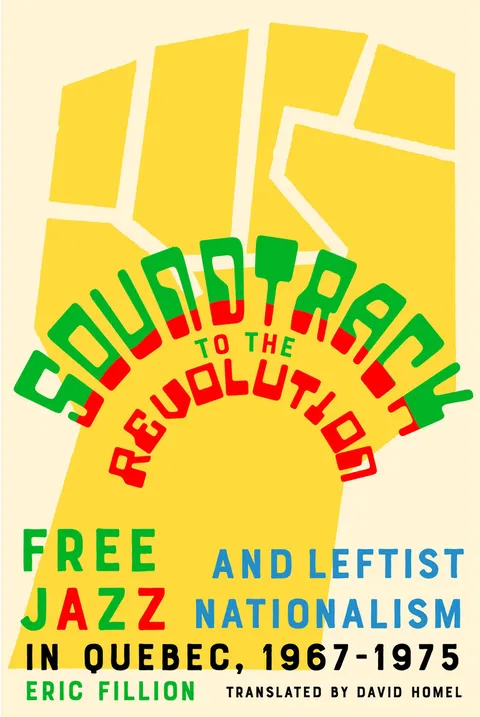
" I am a revolutionary first, a musician second. Instead of a machine gun, I have a trumpet," explained Yves Charbonneau, co-founder of the Montreal-based group Jazz Libre, in May of 1969.
Upbeat excitement resonated throughout Montreal and across the predominantly French-speaking province of Quebec in the wake of the Quiet Revolution and in the immediate aftermath of Expo 67, the highlight of Canada's Centennial celebrations. Yet at the time, the city was also a hub of discordant politics, many of which were about the promises of various types of leftism and their intersection with nationalism. Cultural workers-- individuals, groups, and their networks-- participated actively in these debates, prompting new forms of communication, participation, and organization to catalyze all kinds of evocative solidarities.
In telling the story of Jazz Libre, Soundtrack to the Revolution reveals the meaningful role that the art of spontaneity played in the turbulent 1960s and 1970s. It traces the path taken by Jazz Libre-- a collective of improvisers who embraced free jazz to help legitimize the efforts of the Quebec left to situate its nationalist aspirations within global anti-imperialist and anti-capitalist movements. Charbonneau and his bandmates strongly believed that collective improvisation could inspire resistance and hope by fostering communication, collaboration, initiative, trust, and self-criticism-- but also a disposition to take risks as well as a willingness to think creatively and make decisions on the spur of the moment. Their many initiatives (concert forums aimed at students and workers, a self-governing arts summer camp in Val-David, north of Montreal, a socialist commune in the Eastern Townships as well as an experimental cultural centre in Old Montreal) were all oriented toward the convergence of protest movements shaking Quebec. Jazz Libre's fate was, as a result, irreversibly tied to the leftist independence movement-- a hodgepodge of groups in search of possible futures during these pivotal decades.
Eric Fillion
Eric Fillion is director of the International Institute for Critical Studies in Improvisation and assistant professor at the School of Languages and Literatures at the University of Guelph. He is the author of Distant Stage: Quebec, Brazil, and the Making of Canada's Cultural Diplomacy. With Sean Mills and Désirée Rochat, he co-edited Statesman of the Piano: Jazz, Race, and History in the Life of Lou Hooper He lives in Guelph, Ontario.
More by Eric Fillion
David Homel
Translated by
Award-winning author and literary translator David Homel also works as a journalist, editor and screenwriter. He was born in Chicago in 1952 but left at the end of the tumultuous 1960s and continued his education in Europe and Toronto before settling in 1980 Montreal. He worked at a variety of industrial jobs before beginning to write fiction in the mid-1980s. His eleven novels to date have been translated into several languages and published around the world.


Why Readwise Books?
Readwise Books is an ebook & audiobook platform that automatically logs how much you and your friends read, making it fun and easy to read more. Learn more →