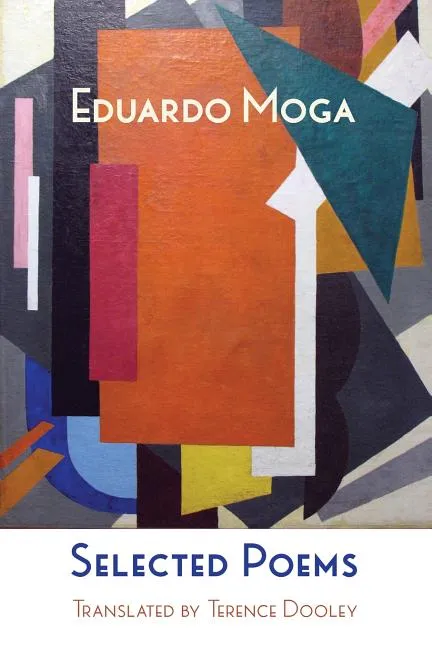
Selected Poems
Report an issue
Tell us what's wrong and we'll take a look.
Thanks – we got it. We'll review and follow up if needed.
We have become used to a life of routine and uniformity: at work, in our relationships with others and with ourselves when we seek to understand what surrounds and subjugates us. Messages flood in and, instead of criticising reality, they reinforce the status quo and encourage us to accept it and maintain it. To counterbalance the hierarchies and justifications of modern life, there are voices raised in protest, like Eduardo Moga's, which don't mourn a presumed lost golden age, or bewail their disillusionment. That phase was left behind for Moga long ago, and we must presume he underwent an apprenticeship of disappointment: the discovery that the gods do not love us, but torment us, and then put all his efforts into unlearning it all. Moga's poetry does not preach, however, or burden us with rules or ideas to bring us to an imaginary better world, here or in the afterlife. The only life is this, the here and now, the life of the body, the life of the senses connecting us to the world. To restore our delight in the present is not a trivial mission and Moga confronts us time and again with our emotions and sensations, with the intention of blotting out thereby the monotonous discourse of the representatives of order. One might think, then, that the poet is acting like a strategist on a battlefield. Far from the Manichaean vision of the soldier, who is unable to see beyond dualities, this poetry is nourished by subtlety, detail and precision. It is not artillery, but a fine wielding of the scalpel which, with the delicacy and determination of the silversmith, dissects the tumour and cyst threatening our life, which is then able to flourish as a result.
Eduardo Moga
Eduardo Moga (Barcelona, 1962) holds a degree in Law and a PhD in Spanish Philology from the University of Barcelona. He has published 18 poetry collections, the main ones being La luz oída (1996), Las horas y los labios (2003), Cuerpo sin mí (2007), Bajo la piel, los días (2010), Insumisión (2013), El corazón, la nada (Antología poética 1994-2014) (2014) and Muerte y amapolas en Alexandra Avenue (2017). His poetry has been translated into English (Selected Poems, Shearsman Books, 2017), Portuguese, French, Catalan, Italian, Czech, Slovak, Polish, Ukrainian and Albanian. He has translated Ramon Llull, Frank O'Hara, Évariste Parny, Charles Bukowski, Carl Sandburg, Arthur Rimbaud, William Faulkner, Walt Whitman, Richard Aldington and Jaume Roig, among other authors. He currently writes as a literary critic for Letras Libres, Cuadernos Hispanoamericanos, Turia and Quimera, among other cultural media. He is responsible for the anthologies Los versos satíricos. Antología de poesía satírica universal (2001), Poesía pasión. Doce jóvenes poetas españoles (2004) and Medio siglo de oro. Antología de la poesía contemporánea en catalán (2014). He has also published travel books, such as La pasión de escribil (2013) and El mundo es ancho y diverso (2018); two selections of posts from his blog Corónicas de Ingalaterra (2015 and 2016), where he gathers his impressions of the two years and a half that he lived in London and, in general, of British society; and several volumes of essays, the most recent ones being La disección de la rosa (2015), Apuntes de un español sobre poetas de América (y algunos de otros sitios) (2016) and Homo legens (2018). He has been director of the Editora Regional de Extremadura and coordinator of the Reading Promotion Plan of Extremadura. He maintains the blogs Corónicas de Ingalaterra and Corónicas de Españia.
More by Eduardo Moga


Why Readwise Books?
Readwise Books is an ebook & audiobook platform that automatically logs how much you and your friends read, making it fun and easy to read more. Learn more →