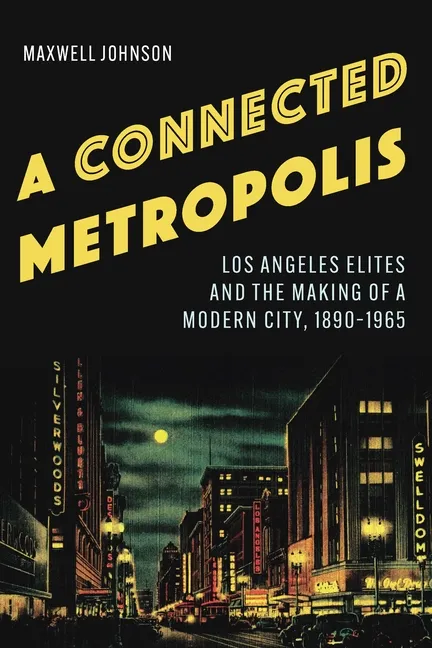
A Connected Metropolis
Los Angeles Elites and the Making of a Modern City, 1890-1965
Report an issue
Tell us what's wrong and we'll take a look.
Thanks – we got it. We'll review and follow up if needed.
At the turn of the twentieth century, the politics of connection revolved around initiatives to tie Los Angeles to other places both tangibly and metaphorically. Elites built tangible connections to secure, among other things, the water that irrigated the citrus farms of Los Angeles, the capital that propelled its businesses, and the people who migrated from the Midwest to buy its houses. To build metaphorical connections that located the city amid transcontinental and trans-Pacific movements, elites themselves often transcended nearby borders and pursued connections at will. Los Angeles stood as a focal point for elite ambitions, a place with a more ambivalent relationship to external connections. The true story of Los Angeles's rise lies in the spectacular visions and rambunctious activism of a group of elite men dedicated to transforming a remote frontier town into a global metropolis.
Maxwell E Johnson
Maxwell E. Johnson is emeritus professor of liturgy at the University of Notre Dame and a retired presbyter in the Evangelical Lutheran Church in America. His numerous publications are on the origins and development of early Christian liturgy, contemporary rites, and current ecumenical and theological questions in both East and West. He is the author and/or editor of more than twenty-five books and over one hundred essays and articles. He is also a former president of the North American Academy of Liturgy, a member of the Society of Oriental Liturgy, a member of Societas Liturgica, and a member of the scientific advisory board for the journal Ecclesia Orans. He has received the Berakah Award from the North American Academy of Liturgy and the Christus Rex Award from the Liturgical Studies Institute at Valparaiso University.
More by Maxwell E Johnson


Why Readwise Books?
Readwise Books is an ebook & audiobook platform that automatically logs how much you and your friends read, making it fun and easy to read more. Learn more →