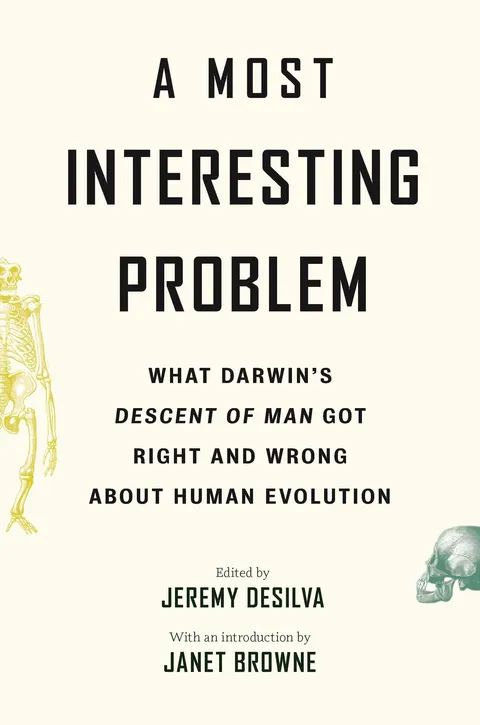
A Most Interesting Problem
What Darwin’s Descent of Man Got Right and Wrong about Human Evolution
Report an issue
Tell us what's wrong and we'll take a look.
Thanks – we got it. We'll review and follow up if needed.
Leading scholars take stock of Darwin's ideas about human evolution in the light of modern science
In 1871, Charles Darwin published The Descent of Man, a companion to Origin of Species in which he attempted to explain human evolution, a topic he called "the highest and most interesting problem for the naturalist." A Most Interesting Problem brings together twelve world-class scholars and science communicators to investigate what Darwin got right—and what he got wrong—about the origin, history, and biological variation of humans.
Edited by Jeremy DeSilva and with an introduction by acclaimed Darwin biographer Janet Browne, A Most Interesting Problem draws on the latest discoveries in fields such as genetics, paleontology, bioarchaeology, anthropology, and primatology. This compelling and accessible book tackles the very subjects Darwin explores in Descent, including the evidence for human evolution, our place in the family tree, the origins of civilization, human races, and sex differences.
A Most Interesting Problem is a testament to how scientific ideas are tested and how evidence helps to structure our narratives about human origins, showing how some of Darwin's ideas have withstood more than a century of scrutiny while others have not.
A Most Interesting Problem features contributions by Janet Browne, Jeremy DeSilva, Holly Dunsworth, Agustín Fuentes, Ann Gibbons, Yohannes Haile-Selassie, Brian Hare, John Hawks, Suzana Herculano-Houzel, Kristina Killgrove, Alice Roberts, and Michael J. Ryan.
Jeremy DeSilva
Jeremy “Jerry” DeSilva is a paleoanthropologist at Dartmouth College specializing in the evolution of early human ancestors (hominins). He is part of a research team that discovered and described two ancient members of the human family tree—Australopithecus sediba and Homo naledi. He has studied wild chimpanzees in Western Uganda and digs for ancient human fossils at sites in Eastern and South Africa. From 1998-2003, Jerry worked as an educator at the Boston Museum of Science and continues to be passionate about science education. He is the author of the 2021 book First Steps: How Upright Walking Made Us Human. Jerry lives in Norwich, Vermont, with his wife Erin and their twins Ben and Josie.







Why Readwise Books?
Readwise Books is an ebook & audiobook platform that automatically logs how much you and your friends read, making it fun and easy to read more. Learn more →