Report an issue
Tell us what's wrong and we'll take a look.
Thanks – we got it. We'll review and follow up if needed.
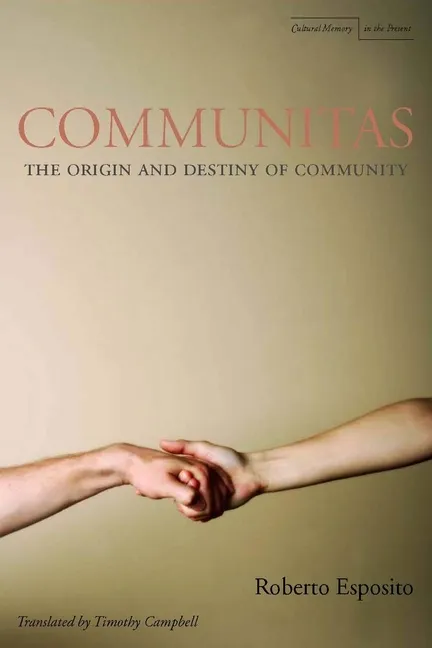
No theme has been more central to international philosophical debates than that of community: from American communitarianism to Habermas's ethic of communication to the French deconstruction of community in the work of Derrida and Nancy. Nevertheless, in none of these cases has the concept been examined from the perspective of community's original etymological meaning: cum munus. In Communitas: The Origin and Destiny of Community, Roberto Esposito does just that through an original counter-history of political philosophy that takes up not only readings of community by Hobbes, Rousseau, Kant, Heidegger and Bataille, but also by Hölderlin, Nietzsche, Canetti, Arendt, and Sartre. The result of his extraordinary conceptual and lexical analysis is a radical overturning of contemporary interpretations of community. Community isn't a property, nor is it a territory to be separated and defended against those who do not belong to it. Rather, it is a void, a debt, a gift to the other that also reminds us of our constitutive alterity with respect to ourselves.


Timothy C. Campbell
Translated by
Timothy C. Campbell is Professor of Italian at Cornell University. His most recent book is The Techne of Giving: Cinema and the Generous Form of Life (Fordham, 2017).


Why Readwise Books?
Readwise Books is an ebook & audiobook platform that automatically logs how much you and your friends read, making it fun and easy to read more. Learn more →