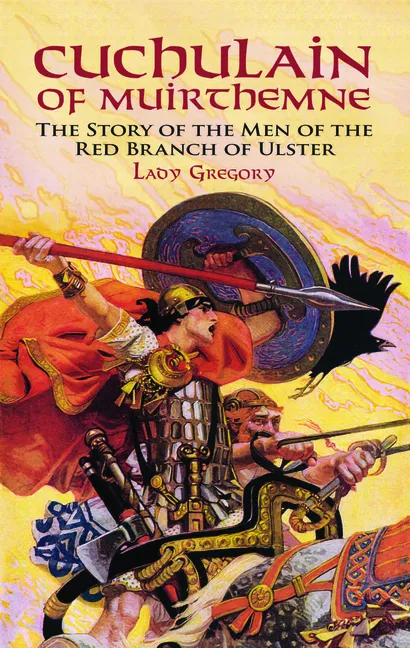
Cuchulain of Muirthemne
Report an issue
Tell us what's wrong and we'll take a look.
Thanks – we got it. We'll review and follow up if needed.
One of the leading lights of the late-19th-century Irish literary renaissance, the Irish writer, folklorist, and playwright Lady Augusta Gregory was instrumental in collecting and preserving the folklore of her country. She translated these tales of the legendary Cuchulain -- an Irish Achilles who was the greatest of ancient Ireland's fabled Knights of the Red Branch -- from the original Irish, melding variants of each tale to achieve, enthralling accounts of the great knight's birth and boyhood deeds, superhuman exploits in love and war, and premature death -- along with the unforgettable story of the beautiful, overpowering love demonstrated by his wife, Emer. All of these events are recounted in the same plain and simple style Lady Gregory first heard in stories told by her childhood nurse.
Of this book by his friend and patroness, W. B. Yeats said, "I think this book is the best that has come out of Ireland in my time. Perhaps I should say that this is the best book that has ever come out of Ireland; for the stories which it tells are a chief part of Ireland's gift to the imagination of the world." Students and scholars of folklore or Celtic mythology will prize this edition for its authentic recounting of the tales and general readers will be delighted both by the imaginative richness of the tales and the beautiful style in which they are told.
Lady Gregory
Isabella Augusta, Lady Gregory, was an Anglo-Irish dramatist, folklorist, and stage manager. She co-founded the Irish Literary Theatre and the Abbey Theatre with William Butler Yeats and Edward Martyn, and she authored several short plays for each. Lady Gregory wrote several novels repeating stories from Irish mythology. She rebelled against British rule despite being born into a class that strongly supported it. Her conversion to cultural nationalism, as indicated by her works, was representative of many of the political fights that occurred in Ireland during her lifetime. Lady Gregory is well noted for her role in the Irish Literary Revival. Her home in Coole Park, County Galway, served as a gathering spot for key Revival leaders, and her early work on the Abbey's board was at least as crucial to the theatre's development as her creative writings. Lady Gregory's motto comes from Aristotle: "To think like a wise man, but to express oneself like the common people." Gregory was born in Roxborough, County Galway, as the youngest daughter of the Anglo-Irish gentry family Persse.
More by Lady Gregory


Why Readwise Books?
Readwise Books is an ebook & audiobook platform that automatically logs how much you and your friends read, making it fun and easy to read more. Learn more →