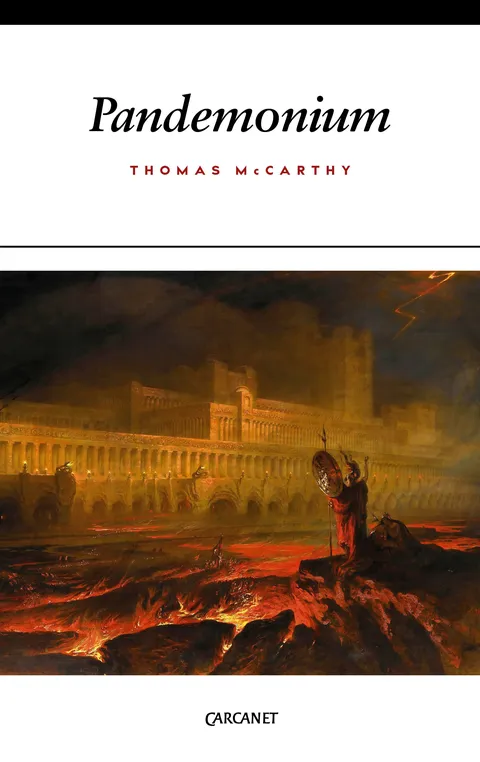
Pandemonium
Report an issue
Tell us what's wrong and we'll take a look.
Thanks – we got it. We'll review and follow up if needed.
Written in the wake of Ireland’s 2008 economic collapse, Thomas McCarthy’s Pandemonium moves between lament and protest in search of a meaningful response in language. Many of the poems were written during a period of retreat along Ireland’s south-west coast, a landscape that imbues McCarthy’s politics with geological intensity. The Atlantic horizon ‘where the sun lies down in the west to die’ is mirrored inland by corruption and rot, a modern Ireland beset, in the poet’s eyes, by financial and moral pandemonium. McCarthy’s subtle satiric wit and understated lyricism preserve raw outrage as historical document. His poems register the moral ire of many during a pivotal era of Irish history, leading with the poet’s only weapon, the word – ‘the ink trail that pain makes on the page’.
Tom McCarthy
Dr. Tom McCarthy, Panthera's Director of Snow Leopard Programs, began his conservation career studying brown bears, black bears, mountain goats and caribou in Alaska in the early 1980s. A strong interest in international conservation led him to Mongolia in 1992, where, under the guidance of Dr. George Schaller (known as "one of the founding fathers of wildlife conservation"), he took over the management of a long-term snow leopard research project. He was the first biologist to use satellite radio-collars on snow leopards. McCarthy became the Science and Conservation Director of the Snow Leopard Trust in 2000 and has since led their extensive science and community-based conservation programs across much of snow leopard range in Asia. From 2002-2009, Dr. McCarthy served as Executive Director of the Snow Leopard Network, a global consortium of more than 200 professionals involved in snow leopard research and conservation. Among other research initiatives, Dr. McCarthy is leading both a range-wide assessment of snow leopard genetics that seeks to identify movement corridors which are critical to maintaining the health and genetic diversity of the species, and a revision of methods by which snow leopard populations can be monitored over time, including such novel non-invasive approaches as fecal genetics, camera trapping and statistical modeling based on sign surveys.
More by Tom McCarthy














Why Readwise Books?
Readwise Books is an ebook & audiobook platform that automatically logs how much you and your friends read, making it fun and easy to read more. Learn more →