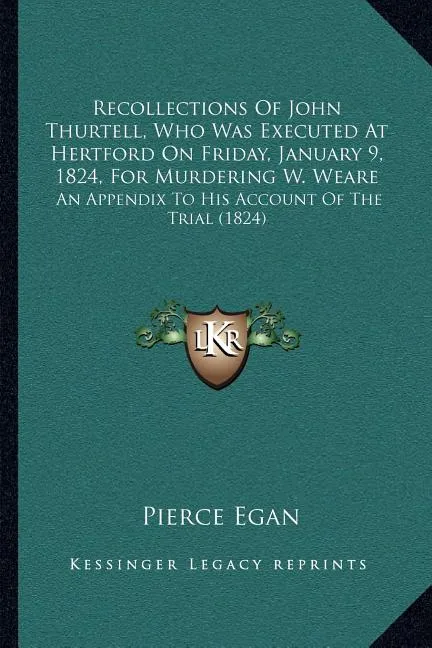
Recollections Of John Thurtell, Who Was Executed At Hertford On Friday, January 9, 1824, For Murdering W. Weare
An Appendix To His Account Of The Trial (1824)
Report an issue
Tell us what's wrong and we'll take a look.
Thanks – we got it. We'll review and follow up if needed.
Recollections of John Thurtell is a book written by Pierce Egan that provides an account of the life and crimes of John Thurtell, a man who was executed for murdering W. Weare in Hertford on Friday, January 9, 1824. The book serves as an appendix to Thurtell's account of the trial, offering additional insights into the events leading up to the murder and the subsequent trial. Egan's book is based on interviews with Thurtell, as well as other sources, and provides a detailed look at the life of a notorious criminal in early 19th-century England. The book offers a glimpse into the criminal underworld of the time, as well as the legal system and the attitudes towards crime and punishment. It is a fascinating historical document that sheds light on a dark period in English history.This scarce antiquarian book is a facsimile reprint of the old original and may contain some imperfections such as library marks and notations. Because we believe this work is culturally important, we have made it available as part of our commitment for protecting, preserving, and promoting the world's literature in affordable, high quality, modern editions, that are true to their original work.
Pierce Egan
Pierce Egan was a British journalist, sportswriter, and pop culture writer. His successful book Life in London, published in 1821, was transformed into the stage play Tom and Jerry, or Life in London later that year, becoming the first play to have a continuous run of 100 performances at the Adelphi Theatre in London's West End. The first collection of his prizefighting essays, Boxiana; or Sketches of Ancient and Modern Pugilism, was published in 1813. He coined the term "the Sweet Science" as an adjective for prizefighting, which he named "the Sweet Science of Bruising" as a description of England's bare-knuckle fight scene. Egan's parents were Irish, however he could have been born in the London region. He moved into printing and worked as a compositor for George Smeeton in 1812. He established himself as the country's leading sports writer, which at the time primarily covered prize bouts and horse racing. He died on August 3, 1849, and was buried on August 10, on the western side of Highgate Cemetery in North London. His plot no longer has a headstone or other identifying markers. The inscription on his grave was included in the book Monumental Inscriptions of Middlesex Vol 2 and reads: "Sacred to the memory of Pierce Egan, Author of various popular works, who died on August 3, 1849.
More by Pierce Egan





Why Readwise Books?
Readwise Books is an ebook & audiobook platform that automatically logs how much you and your friends read, making it fun and easy to read more. Learn more →