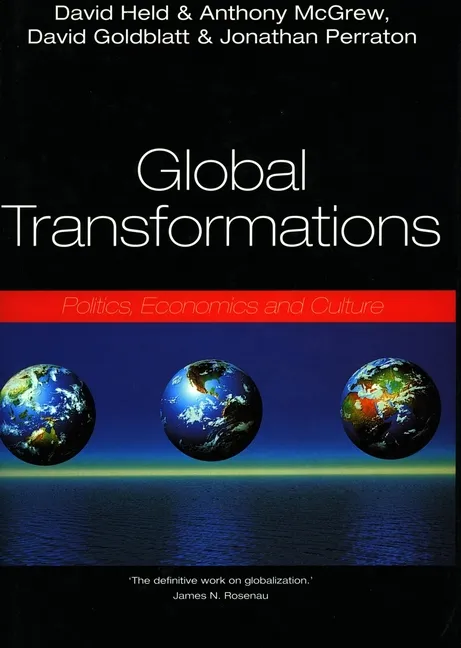
Global Transformations
Politics, Economics, and Culture
Report an issue
Tell us what's wrong and we'll take a look.
Thanks – we got it. We'll review and follow up if needed.
In this book, the authors set forth a new model of globalization that lays claims to supersede existing models, and then use this model to assess the way the processes of globalization have operated in different historic periods in respect to political organization, military globalization, trade, finance, corporate productivity, migration, culture, and the environment. Each of these topics is covered in a chapter which contrasts the contemporary nature of globalization with that of earlier epochs.
In mapping the shape and political consequences of globalization, the authors concentrate on six states in advanced capitalist societies (SIACS): the United States, the United Kingdom, Sweden, France, Germany, and Japan. For comparative purposes, other states-particularly those with developing economics-are referred to and discussed where relevant. The book concludes by systematically describing and assessing contemporary globalization, and appraising the implications of globalization for the sovereignty and autonomy of SIACS. It also confronts directly the political fatalism that surrounds much discussion of globalization with a normative agenda that elaborates the possibilities for democratizing and civilizing the unfolding global transformation.




Anthony McGrew
Chris Armstrong, Momoh Banya, Andrew Mason, Derek McGee, Tony McGrew, David Owen, Clare Saunders, Graham Smith and Gerry Stoker are all based at the Centre for Citizenship, Governance and Globalization at the University of Southampton, UK
More by Anthony McGrew






Why Readwise Books?
Readwise Books is an ebook & audiobook platform that automatically logs how much you and your friends read, making it fun and easy to read more. Learn more →