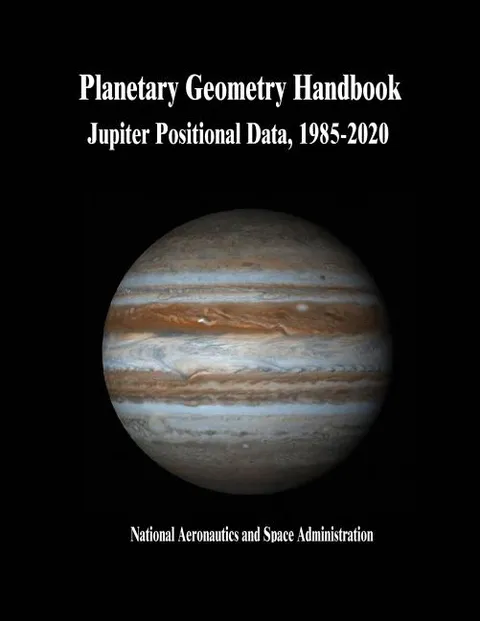
Planetary Geometry Handbook
Jupiter Positional Data, 1985-2020
Report an issue
Tell us what's wrong and we'll take a look.
Thanks – we got it. We'll review and follow up if needed.
This publication contains graphical data necessary for the analysis of planetary exploration missions to Jupiter. Positional and geometric information spanning the time period from 1985 through 2020 is presented; the text explains the data and its usage. This volume is one in a planned series covering planetary mission targets. The purpose of this series of planetary geometry handbooks is to provide mission and science planners, as well as trajectory designers with graphical information sufficient for preliminary mission design and evaluation. It is intended to be used in conjunction with the appropriate volumes and parts of the Mission Design Handbooks. It extends their coverage by commencing in 1985 and continuing to the year 2020. This time span was chosen to provide sufficient mission duration flexibility for all Earth departures through 2005. The present Volume IV is devoted to data on the positions of the planet Jupiter. It presents information characterizing the geocentric and heliocentric positional geometry of a spacecraft while it is in the vicinity of the subject planetary body. The spacecraft could encompass a lander, an entry probe, or a flyby vehicle at encounter. Such wide usage of the data is possible because planetary positions change but slowly, while the distances to Earth or Sun are always large compared to those between the spacecraft and the target planet during the encounter.











Why Readwise Books?
Readwise Books is an ebook & audiobook platform that automatically logs how much you and your friends read, making it fun and easy to read more. Learn more →