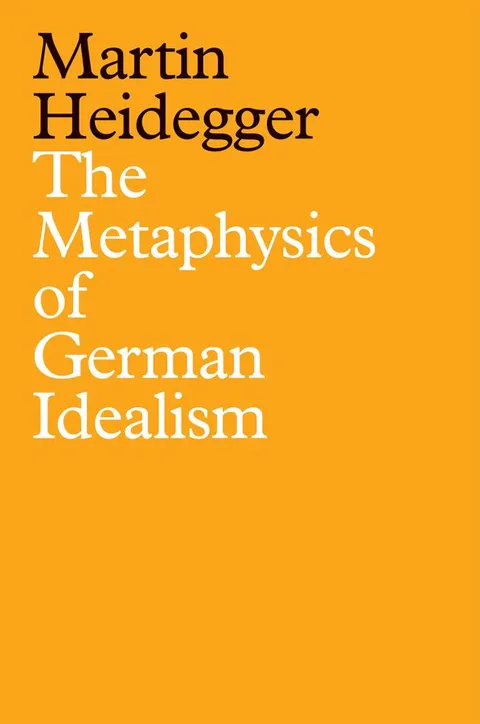
The Metaphysics of German Idealism
A New Interpretation of Schelling's Philosophical Investigations into the Essence of Human Freedom and Matters
Report an issue
Tell us what's wrong and we'll take a look.
Thanks – we got it. We'll review and follow up if needed.
This volume comprises the lecture course that Heidegger gave in 1941 on the metaphysics of German Idealism. The first part of the lecture course contains a preliminary consideration of the distinction between ground and existence. The elucidation of the conceptual history includes a striking confrontation with Kierkegaard's and Jaspers' concepts of existence, as well as an elucidation of the concept of existence in Being and Time, which Heidegger distinguishes from the former concepts. Heidegger's self-interpretation is not an end in itself, however, but rather a way of pointing to Schelling's distinction between ground and existence, whose root and inner necessity and whose various versions Heidegger discusses subsequently.
The second part of the lecture course is focused on Schelling's 'freedom treatise', which Heidegger regards as the pinnacle of the metaphysics of German Idealism. Heidegger's consideration of Schelling's distinction between ground and existence finds its guiding thread in the introduction of the realms of being – eternal or finite, each being is a joining of the ground of existence and existence itself. In a subsequent overview, Heidegger discusses the relation of the distinction between ground and existence to the essence of human freedom and to the essence of the human. On the basis of this discussion, it becomes possible to grasp the connection between freedom and evil in Schelling's system.
This important work by Heidegger, published here in English for the first time, will be of great interest to students and scholars of philosophy and to anyone interested in Heidegger's work.
Martin Heidegger
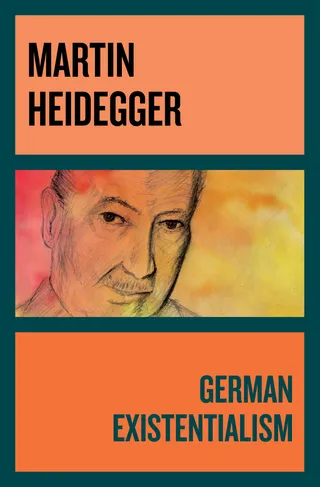
Heidegger’s contribution to the growth and development of National Socialism was immense. In this small anthology, Dr. Runes endeavors to point to the utter confusion Heidegger created by drawing, for political and social application of his own existentialism and metaphysics, upon the decadent and repulsive brutalization of Hitlerism. Martin Heidegger was a philosopher most known for his contributions to German phenomenological and existential thought. Heidegger was born in rural Messkirch in 1889 to Catholic parents. While studying philosophy and mathematics at Albert-Ludwig University in Freiburg, Heidegger became the assistant for the philosopher Edmund Husserl. Influenced by Husserl, Kierkegaard, and Nietzsche, Heidegger wrote extensively on the quality of Being, including his Opus Being and Time. He served as professor of philosophy at Albert-Ludwig University and taught there during the war. In 1933, Heidegger joined the National Socialist German Worker’s (or Nazi) Party and expressed his support for Hitler in several articles and speeches. After the war, his support for the Nazi party came under attack, and he was tried as a sympathizer. He was able to return to Albert Ludwig University, however, and taught there until he retired. Heidegger continued to lecture until his death in 1973.
More by Martin Heidegger




Ian Alexander Moore
Translated by
Ian Alexander Moore is a faculty member at St. John's College in Santa Fe, New Mexico, and associate editor of the journal Philosophy Today.


Why Readwise Books?
Readwise Books is an ebook & audiobook platform that automatically logs how much you and your friends read, making it fun and easy to read more. Learn more →