Report an issue
Tell us what's wrong and we'll take a look.
Thanks – we got it. We'll review and follow up if needed.
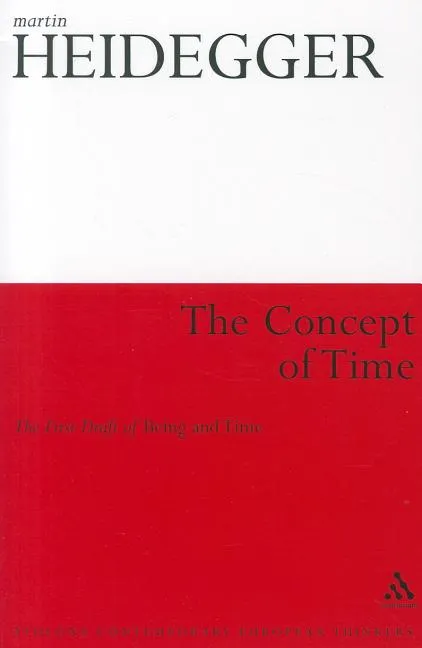
The Concept of Time presents Heidegger's so-called Dilthey review, widely considered the first draft of his celebrated masterpiece, Being and Time. Here Heidegger reveals his deep commitment to Wilhelm Dilthey and Count Yorck von Wartenburg. He agrees with them that historicity must be at the centre of the new philosophy to come. However, he also argues for an ontological approach to history. From this ontological turn he develops the so-called categories of Dasein.
This work demonstrates Heidegger's indebtedness to Yorck and Dilthey and gives further evidence to the view that thought about history is the germ cell of Being and Time. However, it also shows that Heidegger's commitment to Dilthey was not without reservations and that his analysis of Dasein actually employs Husserl's phenomenology. The work reopens the question of history in a broader sense, as Heidegger struggles to thematize history without aligning it with world-historical events. The text also provides a concise and readable summary of the main themes of Being and Time and as such is an ideal companion to that text.
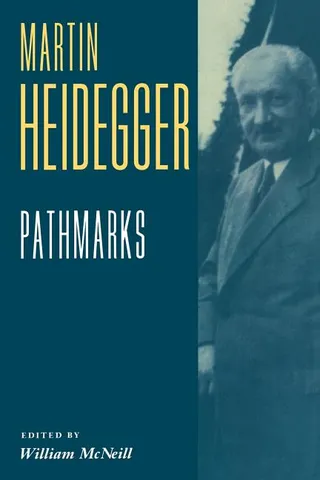
Martin Heidegger
Heidegger’s contribution to the growth and development of National Socialism was immense. In this small anthology, Dr. Runes endeavors to point to the utter confusion Heidegger created by drawing, for political and social application of his own existentialism and metaphysics, upon the decadent and repulsive brutalization of Hitlerism. Martin Heidegger was a philosopher most known for his contributions to German phenomenological and existential thought. Heidegger was born in rural Messkirch in 1889 to Catholic parents. While studying philosophy and mathematics at Albert-Ludwig University in Freiburg, Heidegger became the assistant for the philosopher Edmund Husserl. Influenced by Husserl, Kierkegaard, and Nietzsche, Heidegger wrote extensively on the quality of Being, including his Opus Being and Time. He served as professor of philosophy at Albert-Ludwig University and taught there during the war. In 1933, Heidegger joined the National Socialist German Worker’s (or Nazi) Party and expressed his support for Hitler in several articles and speeches. After the war, his support for the Nazi party came under attack, and he was tried as a sympathizer. He was able to return to Albert Ludwig University, however, and taught there until he retired. Heidegger continued to lecture until his death in 1973.
More by Martin Heidegger











Why Readwise Books?
Readwise Books is an ebook & audiobook platform that automatically logs how much you and your friends read, making it fun and easy to read more. Learn more →