
Report an issue
Tell us what's wrong and we'll take a look.
Thanks – we got it. We'll review and follow up if needed.
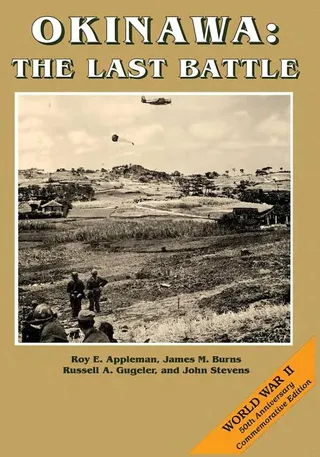
Okinawa: The Last Battle is a tactical history of the conquest of the Ryukyu Islands by forces under the command of the U.S. Tenth Army in the period 1 April to 30 June 1945. The volume takes its name from the principal island of the Ryukyu island group, where the critical and decisive battles of the campaign were fought. The Ryukyus Campaign followed the capture of Iwo Jima and was planned as the last of the Pacific island operations before the invasion of Japan itself. This work is an account of all United States forces engaged--Army, Navy, Air, and Marine. It also tells in considerable detail the story of the Japanese 32d Army, which was the Okinawa garrison, and of Japanese naval and air forces committed in the defense of the Ryukyus. The volume begins with the planning for this amphibious operation at the threshold of Japan, one of the largest of the Pacific war, and follows the operation through all succeeding phases to the death of the Japanese commanding general and his chief of staff. Of special interest was the tremendous volume of naval firepower employed by ships stationed offshore on the flanks of the American ground forces as the latter advanced across the island. The concentration of naval, air, and ground firepower employed by American forces in the Okinawa campaign was unparalleled for any comparable force, length of front, and duration of time in the history of warfare. Nevertheless, blunting this great firepower was the most extensive network of underground cave and tunnel defenses with tightly interlocking fields of fire encountered in the history of warfare. The Japanese defensive system stretched from coast to coast and converged ring upon ring in depth, with Shuri, the ancient capital of the Ryukyus, at its center. The battle resolved itself into a myriad of small-unit actions against enemy cave and firing positions. This fight was conducted at close quarters by infantry-engineer and infantry-tank teams. Tank flamethrowers and engineer and infantry demolition teams, covered by small groups of riflemen, often formed the combat units that enabled Tenth Army slowly to destroy the many well-constructed defensive positions, eliminate their dedicated defenders, and move gradually forward. The extensive attacks of Japanese Kamikaze pilots against the American naval forces supporting the ground forces are also treated as an important part of the operation. The ground combat story is told principally from regimental level. But as often as not, the treatment goes down to battalion level and frequently to company, platoon, and squad. It was the small unit that normally destroyed a particular enemy position holding the key to further advances. Often it was the individual soldier whose heroism was the decisive factor in such laborious activities, making it the theme of the immediate narrative. The XXIV Army Corps and the III Amphibious Corps, U.S. Fleet Marine Force, were the principal subordinate units of Tenth Army. In the two corps were the Army's 7th, 27th, 77th, and 96th Infantry Divisions and the 1st and 6th Marine Divisions. In addition, the 2d Marine Division played a minor role in the preinvasion maneuvers, and its 18th Regiment was in limited action for a few days toward the end of the campaign.
James MacGregor Burns
James MacGregor Burns (1918–2014) was a bestselling American historian and political scientist whose work earned both the National Book Award and a Pulitzer Prize. Born in Boston, Burns fell in love with politics and history at an early age. He earned his BA at Williams College, where he returned to teach history and political science after obtaining his PhD at Harvard and serving in World War II. Burns’s two-volume biography of Franklin D. Roosevelt is considered the definitive examination of the politician’s rise to power, and his groundbreaking writing on the subject of political leadership has influenced scholars for decades. Most recently, he served as the Woodrow Wilson Professor of Government Emeritus at Williams College and as Distinguished Leadership Scholar at the University of Maryland.
More by James MacGregor Burns

















Why Readwise Books?
Readwise Books is an ebook & audiobook platform that automatically logs how much you and your friends read, making it fun and easy to read more. Learn more →