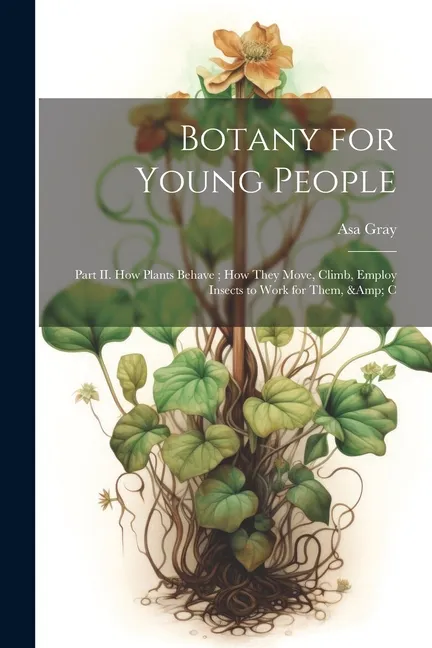
Botany for Young People
Part II. How Plants Behave; how They Move, Climb, Employ Insects to Work for Them, & C
Report an issue
Tell us what's wrong and we'll take a look.
Thanks – we got it. We'll review and follow up if needed.
In this engaging and informative book, Asa Gray explains the behaviors of plants and their adaptations to their environment in accessible language for young readers. The book includes illustrations to help readers understand the concepts presented. A great resource for budding botanists and curious minds alike.
This work has been selected by scholars as being culturally important, and is part of the knowledge base of civilization as we know it.
This work is in the "public domain in the United States of America, and possibly other nations. Within the United States, you may freely copy and distribute this work, as no entity (individual or corporate) has a copyright on the body of the work.
Scholars believe, and we concur, that this work is important enough to be preserved, reproduced, and made generally available to the public. We appreciate your support of the preservation process, and thank you for being an important part of keeping this knowledge alive and relevant.
Asa Gray
Asa Gray, who lived from November 18, 1810, to January 30, 1888, is regarded as the most significant American botanist of the 1800s. His Darwiniana was seen as a seminal account of how science and faith did not always have to conflict. Gray insisted that all members of a species have to be genetically related. Additionally, he was adamantly against the concepts of special creation, which prevents evolution, and hybridization within a single generation. Despite the fact that Gray's theistic evolution was directed by a Creator, he was a fervent Darwinist. Throughout his many years as a botany professor at Harvard University, Gray maintained regular correspondence and visits with many of the top natural scientists of the day, including Charles Darwin, who thought highly of him. In addition to visits to the southern and western regions of the United States, Gray made multiple travels to Europe in order to work with prominent European scientists of the day. He also established a wide network of collectors of specimens. Being a prolific writer, he played a significant role in bringing North American plant taxonomy together.
More by Asa Gray


Why Readwise Books?
Readwise Books is an ebook & audiobook platform that automatically logs how much you and your friends read, making it fun and easy to read more. Learn more →