Report an issue
Tell us what's wrong and we'll take a look.
Thanks – we got it. We'll review and follow up if needed.
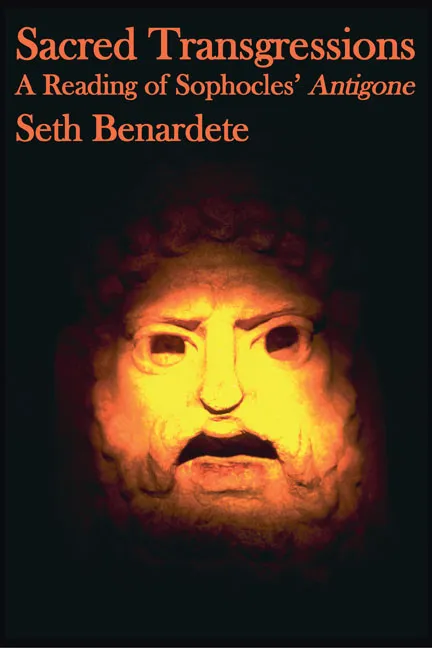
This detailed commentary on the action and argument of Sophocles' Antigone is meant to be a reflection on and response to Hegel's interpretation in the Phenomenology (VI.A.a-b), and includes, in addition, two appendixes dealing with Aeschylus' Septem. It thus moves within the principles Hegel discovers in the play but reinserts them into the play as they show themselves across the eccentricities of its plot. Wherever plot and principles do not match, there is a glimmer of the argument: Haemon speaks up for the city and Tiresias for the divine law but neither for Antigone. The guard who reports the burial and presents Antigone to Creon is as important as Antigone or Creon for understanding Antigone. The Chorus too in their inconsistent thoughtfulness have to be taken into account, and in particular how their understanding of the canniness of man reveals Antigone in their very failure to count her as a sign of man's uncanninesss: She who is below the horizon of their awareness is at the heart of their speech. Megareus, the old son of Creon, who sacreficied his life for the city, looms as large as Eurydice, whose suicide has nothing in common with Antigone's. She is "all-mother"; Antigone is anti-generation.


Why Readwise Books?
Readwise Books is an ebook & audiobook platform that automatically logs how much you and your friends read, making it fun and easy to read more. Learn more →