Report an issue
Tell us what's wrong and we'll take a look.
Thanks – we got it. We'll review and follow up if needed.
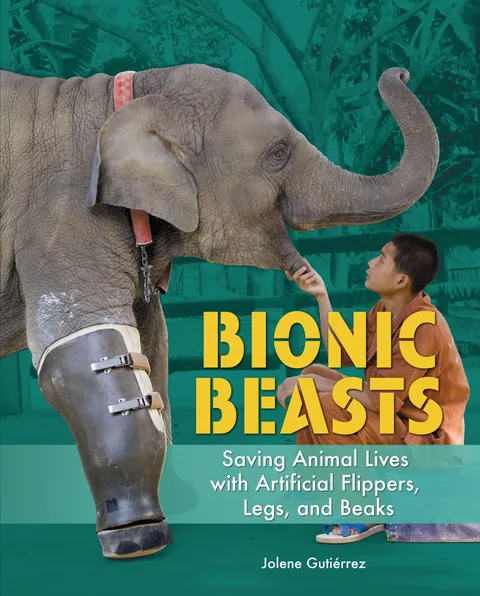
What happens when a young elephant steps on a buried land mine? What happens when a sea turtle’s flipper is injured by a predator?
Thanks to recent advances in technology, we have new ways to design and build prosthetic body parts that can help these animals thrive.
Meet an Asian elephant named Mosha, a Kemp’s ridley sea turtle named Lola, a German Shepherd named Cassidy, a greylag goose named Vitória, and Pirate, a Berkshire-Tamworth pig. Each of these animals was struggling, but through a variety of techniques and technologies, humans created devices that enabled the animals to live and move more comfortably.
Discover the stories of how veterinarians, doctors, and even students from around the world used 3D printing and other techniques to build bionic body parts for these amazing animals.
Jolene Gutiérrez
Jolene Gutiérrez is an award-winning teacher-librarian who has been working with diverse learners at Denver Academy for the past 28 years. When she was little, she would squint to protect her eyes from bright lights and cover her ears to protect herself from loud noises. Now, she wears sunglasses when she's outside and brings earplugs if she thinks she'll need them. She didn't immediately recognize her own kids' sensory processing issues because their struggles looked different from her own. She hopes Too Much! will help caregivers and educators recognize and support sensory processing challenges.
More by Jolene Gutiérrez





Why Readwise Books?
Readwise Books is an ebook & audiobook platform that automatically logs how much you and your friends read, making it fun and easy to read more. Learn more →