Report an issue
Tell us what's wrong and we'll take a look.
Thanks – we got it. We'll review and follow up if needed.
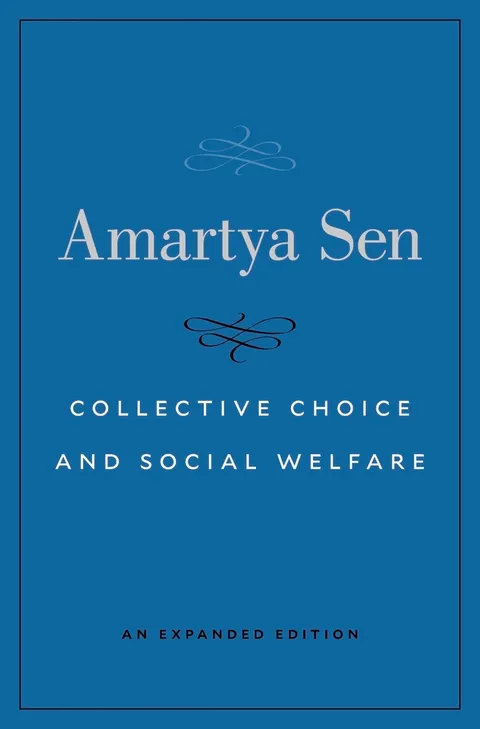
Originally published in 1970, this classic study has been recognized for its groundbreaking role in integrating economics and ethics, and for its influence in opening up new areas of research in social choice, including aggregative assessment. It has also had a large influence on international organizations, including the United Nations, notably in its work on human development. The book showed that the "impossibility theorems" in social choice theory--led by the pioneering work of Kenneth Arrow--do not negate the possibility of reasoned and democratic social choice.
Sen's ideas about social choice, welfare economics, inequality, poverty, and human rights have continued to evolve since the book's first appearance. This expanded edition preserves the text of the original while presenting eleven new chapters of fresh arguments and results.
"Expanding on the early work of Condorcet, Pareto, Arrow, and others, Sen provides rigorous mathematical argumentation on the merits of voting mechanisms...For those with graduate training, it will serve as a frequently consulted reference and a necessity on one's book shelf."
--J. F. O'Connell, Choice
Amartya Sen
Amartya Sen is a professor of economics and philosophy at Harvard University. A former master of Trinity College, Cambridge, he won the Nobel Prize for Economics in 1998. His many celebrated books include Development as Freedom and The Idea of Justice. He lives in Cambridge, Massachusetts.
More by Amartya Sen










Why Readwise Books?
Readwise Books is an ebook & audiobook platform that automatically logs how much you and your friends read, making it fun and easy to read more. Learn more →