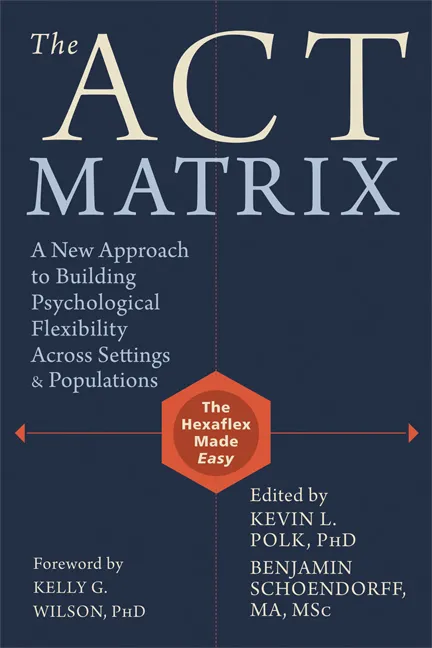
The Act Matrix
A New Approach to Building Psychological Flexibility Across Settings & Populations
Report an issue
Tell us what's wrong and we'll take a look.
Thanks – we got it. We'll review and follow up if needed.
If you are an ACT practitioner or mental health professional, this eagerly awaited resource is an essential addition to your professional library.
Acceptance and commitment therapy (ACT) is an evidence-based therapy that has been successful in treating a variety of psychological issues, such anxiety, depression, substance abuse, trauma, eating disorders, and more. In contrast to other treatment options, ACT has proven extremely effective in helping clients who are "stuck" in unhealthy thought patterns by encouraging them align their values with their thoughts and actions. However, the ACT model is complex, and it's not always easy to use.
Traditionally, ACT is delivered with a focus around six core processes that are often referred to as the hexaflex: cognitive defusion, acceptance, contact with the present moment, observing the self, values, and committed action. Each of these core processes serves a specific function, but they are often made more complex than needed in both theory and in practice. So what if there was a way to simplify ACT in your sessions with clients?
Edited by clinical psychologists and popular ACT workshop leaders Kevin L. Polk and Benjamin Schoendorff, The ACT Matrix fuses the six core principles of acceptance and commitment therapy (ACT) into a simplified, easy-to-apply approach that focuses on client actions and behavior as workable or unworkable, rather than good or bad. Most importantly, you'll learn how this innovative approach can be used to deliver ACT more effectively in a variety of settings and contexts, even when clients are resistant or unmotivated to participate.
This is the first book to utilize the ACT Matrix model, and it is a must-read for any ACT practitioner looking to streamline his or her therapeutic approach.
Kevin L Polk
Kevin L. Polk, PhD, is a clinical psychologist who has been a practicing for twenty-six years, primarily helping veterans and others with troubling trauma memories. For the past eleven years, he has dedicated himself to the study of acceptance and commitment therapy (ACT)--spending close to 27,000 hours studying the philosophy and theory behind ACT, and learning and designing ACT interventions. He is passionate about teaching others how to use the ACT Matrix to increase psychological flexibility and valued living. Find out more at www.drkevinpolk.com.
Benjamin Schoendorff
Benjamin Schoendorff, MA, MSc, is director of the Contextual Psychology Institute in Montreal, QC, Canada. He is involved in ACT research at the Montreal University Mental Health Institute, and a clinical psychologist in private practice working with adults, children, teens, and couples. Schoendorff is passionate about making ACT simple for both therapists and clients. He's authored and coauthored several ACT books in French, coedited The ACT Matrix with Kevin Polk, and coauthored The ACT Practitioner's Guide to the Science of Compassion with Dennis Tirch and Laura Silberstein. A peer-reviewed ACT trainer and certified functional analytic psychotherapy (FAP) trainer, Schoendorff has led approximately two-hundred workshops around the world, and is currently disseminating the six-step ACT Matrix approach at the heart of this book. His workshops are widely appreciated for their direct clinical applicability, deep humanity, and warm sense of humor. In his spare time, Schoendorff loves travelling with his wife and young son Thomas, and sharing his love for ACT and the Matrix. Find out more at www.contextpsy.com.


Why Readwise Books?
Readwise Books is an ebook & audiobook platform that automatically logs how much you and your friends read, making it fun and easy to read more. Learn more →