Report an issue
Tell us what's wrong and we'll take a look.
Thanks – we got it. We'll review and follow up if needed.
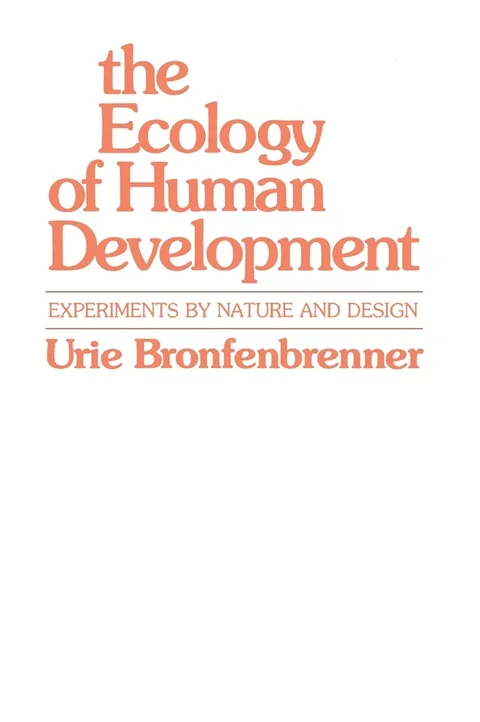
A landmark study that transformed how we understand human development by showing how families, communities, institutions, and cultures shape who we become.
Here is a book that challenges the very basis of the way psychologists have studied child development. According to Urie Bronfenbrenner, one of the world's foremost developmental psychologists, laboratory studies of the child's behavior sacrifice too much in order to gain experimental control and analytic rigor. Laboratory observations, he argues, too often lead to "the science of the strange behavior of children in strange situations with strange adults for the briefest possible periods of time." To understand the way children actually develop, Bronfenbrenner believes that it will be necessary to observe their behavior in natural settings, while they are interacting with familiar adults over prolonged periods of time.
This book offers an important blueprint for constructing such a new and ecologically valid psychology of development. The blueprint includes a complete conceptual framework for analysing the layers of the environment that have a formative influence on the child. This framework is applied to a variety of settings in which children commonly develop, ranging from the pediatric ward to daycare, school, and various family configurations. The result is a rich set of hypotheses about the developmental consequences of various types of environments. Where current research bears on these hypotheses, Bronfenbrenner marshals the data to show how an ecological theory can be tested. Where no relevant data exist, he suggests new and interesting ecological experiments that might be undertaken to resolve current unknowns.
Bronfenbrenner's groundbreaking program for reform in developmental psychology is certain to be controversial. His argument flies in the face of standard psychological procedures and challenges psychology to become more relevant to the ways in which children actually develop. It is a challenge psychology can ill-afford to ignore.
Urie Bronfenbrenner
Urie Bronfenbrenner is the Jacob Gould Schurman Professor Emeritus of Human Development and Psychology at Cornell University. He is best known as the founder and principal protagonist of his ground-breaking theory of the "Ecology of Human Development." Bronfenbrenner is one of the founders of Head Start and the recipient of numerous distinguished awards including six honorary degrees, three from European universities. He was the first recipient of the American Psychological Association′s annual Bronfenbrenner Award for Lifetime Contribution to Developmental Psychology in the Service of Science and Society. He has taught, lectured, consulted, and carried out research in the United States and all over the world, mainly in both Eastern and Western Europe, Japan, and Australia. His publications have been extensive and far-reaching . Urie Bronfenbrenner is a member of the American Academy of Arts and Sciences, American Psychological Society, American Psychological Association, Society for Research in Child Development, National Academy of Education, and the International Society for the Study of Behavioral Development. Bronfenbrenner received his Bachelor′s degree in Psychology and Music from Cornell University, his Master′s Degree from Harvard University, and his Doctorate from the University of Michigan. After service in the Armed Forces and a brief period at the University of Michigan, he returned to Cornell University for a long productive life of research and teaching, as well as assisting with the raising of his six children. Since his retirement in 1987, he has continued to research, to write, to teach, and to travel extensively.
More by Urie Bronfenbrenner












Why Readwise Books?
Readwise Books is an ebook & audiobook platform that automatically logs how much you and your friends read, making it fun and easy to read more. Learn more →