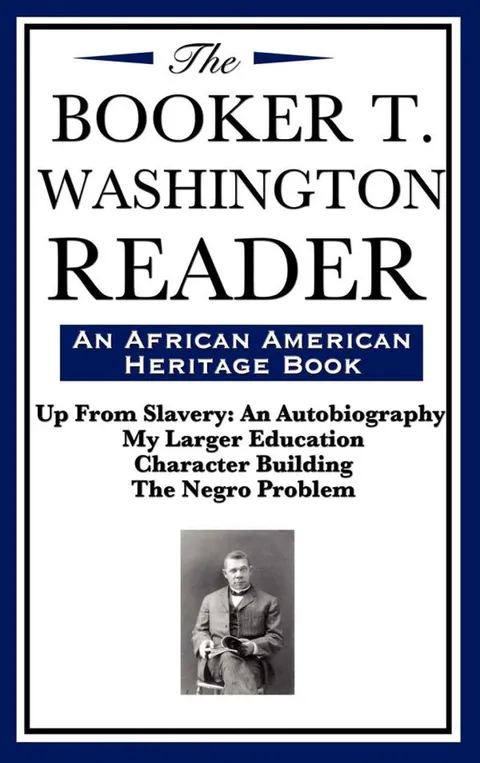
The Booker T. Washington Reader
Report an issue
Tell us what's wrong and we'll take a look.
Thanks – we got it. We'll review and follow up if needed.
Here in one omnibus edition are Booker T. Washington's most important books. Washington was constantly, and often bitterly, criticized by his contemporaries for being too conciliatory to whites and not concerned enough about civil rights. It would not be until after his death that the world would find out that he had indeed worked a great deal for civil rights anonymously behind the scenes. Up from Slavery is one of the most influential biographies ever written. On one level it is the life story of Booker T. Washington and his rise from slavery to accomplished educator and activist. On another level it the story of how an entire race strove to better itself. Washington makes it clear just how far race relations in America have come, and to some extent, just how much further they have to go. Written with wit and clarity. In My Larger Education, Booker T. Washington explains how he came by his positions on race relations, by describing the people who influenced him during the founding of Tuskegee Normal and Industrial Institute of Alabama. In Character Building are thirty seven addresses that Booker T. Washington gave before students, faculty, and guests at the Tuskegee Institute. These addresses take the form of timeless advice on a number of subjects. Very motivational and uplifting. Here are six historic essays on the state of race relations during the Reconstruction and early twentieth century, written from the African American point of view. Included are "Industrial Education for the Negro" by Booker T. Washington, "The Talented Tenth" by W.E. Burghardt DuBois, "The Disfranchisement of the Negro" by Charles W. Chesnutt, "The Negro and the Law" by Wilford H. Smith, "The Characteristics of the Negro People" by H.T. Kealing, and "Representative American Negroes" by Paul Laurence Dunbar.
Booker T. Washington
Born into slavery, Booker T. Washington (1856–1915) went on to become an American educator, author, and adviser to the presidents of the United States. As a self-educated man, Washington believed in accessible education for the post-slavery black community. In 1881, Washington became the first leader of the Tuskegee Institute, an all-black school. In 1895, due to lynching plaguing the South, Washington gave his infamous “Atlanta Compromise” speech, which brought him national recognition. Washington became a seminal leader in the field of Black politics, working with communities to build schools and churches despite the criticism he faced for his involvement with prominent white leaders. His prolific writing career includes fourteen books, most notably Up from Slavery and The Future of the American Negro.
More by Booker T. Washington



Why Readwise Books?
Readwise Books is an ebook & audiobook platform that automatically logs how much you and your friends read, making it fun and easy to read more. Learn more →