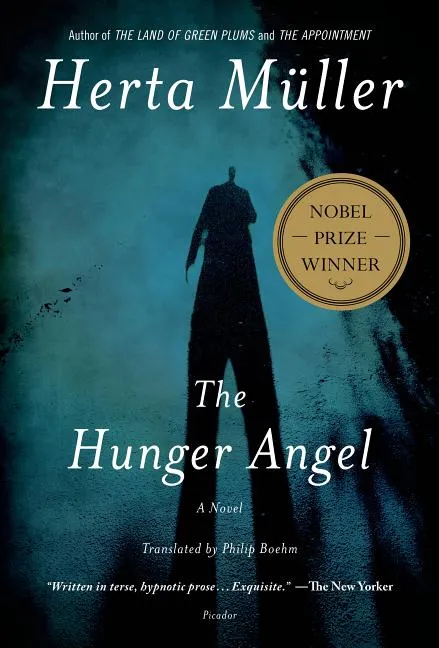
Hunger Angel
Report an issue
Tell us what's wrong and we'll take a look.
Thanks – we got it. We'll review and follow up if needed.
A masterful new novel from the winner of the 2009 Nobel Prize, hailed for depicting the "landscape of the dispossessed" with "the concentration of poetry and the frankness of prose" (Nobel Prize Committee)
It was an icy morning in January 1945 when the patrol came for seventeen-year-old Leo Auberg to deport him to a camp in the Soviet Union. Leo would spend the next five years in a coke processing plant, shoveling coal, lugging bricks, mixing mortar, and battling the relentless calculus of hunger that governed the labor colony: one shovel load of coal is worth one gram of bread.
In The Hunger Angel, Nobel laureate Herta Müller calls upon her unique combination of poetic intensity and dispassionate precision to conjure the distorted world of the labor camp in all its physical and moral absurdity. She has given Leo the language to express the inexpressible, as hunger sharpens his senses into an acuity that is both hallucinatory and profound. In scene after disorienting scene, the most ordinary objects accrue tender poignancy as they acquire new purpose--a gramophone box serves as a suitcase, a handkerchief becomes a talisman, an enormous piece of casing pipe functions as a lovers' trysting place. The heart is reduced to a pump, the breath mechanized to the rhythm of a swinging shovel, and coal, sand, and snow have a will of their own. Hunger becomes an insatiable angel who haunts the camp, but also a bare-knuckled sparring partner, delivering blows that keep Leo feeling the rawest connection to life.
Müller has distilled Leo's struggle into words of breathtaking intensity that take us on a journey far beyond the Gulag and into the depths of one man's soul.
Herta Müller
Herta Müller is the winner of the 2009 Nobel Prize in Literature, as well as the International IMPAC Dublin Literary Award and the European Literature Prize. She is the author of, among other books, The Hunger Angel and The Land of Green Plums. Born in Romania in 1953, Müller lost her job as a teacher and suffered repeated threats after refusing to cooperate with Ceausescu's secret police. She succeeded in emigrating in 1987 and now lives in Berlin.
More by Herta Müller

Philip Boehm
Translated by
Philip Boehm has translated more than thirty novels and plays by German and Polish writers, including Herta M�ller, Franz Kafka and Hanna Krall. Nonfiction translations include A Woman in Berlin by Anonymous and Words to Outlive Us, a collection of eyewitness accounts from the Warsaw Ghetto. For these translations he has received numerous awards including fellowships from the NEA and the John Simon Guggenheim Memorial Foundation. He also works as a theater director and playwright: works for the stage include Alma en venta, Mixtitlan, and Return of the Bedbug. He is the founding Artistic Director of Upstream Theater in St. Louis, which in 2010 was awarded a National Theatre Company grant by the American Theatre Wing (Founder of the Tonys).


Why Readwise Books?
Readwise Books is an ebook & audiobook platform that automatically logs how much you and your friends read, making it fun and easy to read more. Learn more →