Report an issue
Tell us what's wrong and we'll take a look.
Thanks – we got it. We'll review and follow up if needed.
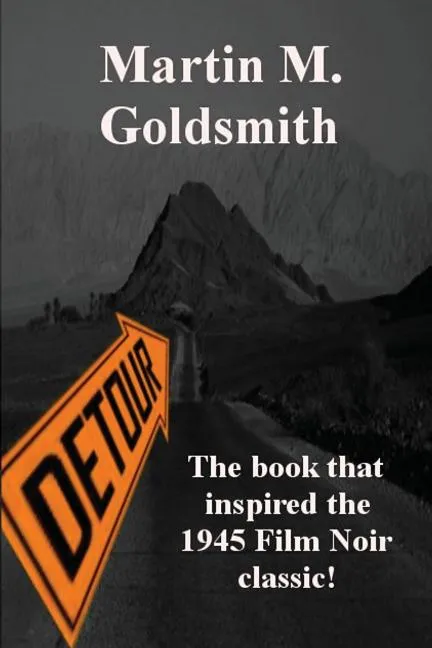
A broke nightclub pianist hitchhikes west toward Los Angeles and walks straight into one of the bleakest traps in American noir. In Detour, Al Roberts is trying to reach the woman he loves, but the road turns into a nightmare of bad luck, desperation, fear, and suspicion. A stranger's death, a dangerous woman, and one terrible decision after another pull him into a tightening spiral where innocence, guilt, and fate become almost impossible to separate.
Martin M. Goldsmith's novel is lean, bitter, fatalistic crime fiction, driven by the same hard-edged atmosphere that later made the film adaptation a landmark of film noir. The story moves through highways, cheap rooms, bars, borrowed identities, and the psychological wreckage of people living close to the edge. Its power comes from the voice of a man who insists he is trapped by circumstance even as his choices keep making the trap worse.
For readers of classic noir, hard-boiled crime fiction, Depression-era and wartime American fiction, psychological suspense, and film-noir source novels, Detour remains a sharp, compact study of doom on the open road. It is a perfect Black Curtain title: fast, dark, morally cornered, and haunted by the possibility that fate may simply be the name people give to their own worst decisions.
Martin M Goldsmith
Martin M. Goldsmith (1913-1994) was an American novelist and screenwriter best remembered for Detour, the dark crime novel that became the basis for Edgar G. Ulmer's celebrated 1945 film noir. Born in New York, Goldsmith worked in fiction and motion pictures during a period when American popular storytelling was moving easily between pulp magazines, novels, radio, theater, and Hollywood. His writing drew on the hard-boiled atmosphere of the 1930s and 1940s, with particular attention to drifters, performers, criminals, desperate lovers, and people caught in the machinery of bad choices.Goldsmith's Detour stands as his most enduring work because of its compressed structure, fatalistic voice, and powerful sense of doom. The novel's movement across the American road gives it the shape of a journey, but its real subject is entrapment: how fear, poverty, desire, chance, and self-deception can narrow a life until every available exit seems to close. Its later film version became one of the defining low-budget noirs, helping keep Goldsmith's story alive for generations of crime readers and film scholars.In addition to fiction, Goldsmith worked as a screenwriter, contributing to films and television in the mid-twentieth century. His association with noir and crime storytelling has made him a figure of continuing interest to readers of hard-boiled fiction, collectors of film-source novels, and students of American noir. Though not as widely known as some of the major crime writers of his era, Goldsmith's best work belongs firmly in the dark current of American suspense fiction where accident, guilt, desire, and fatalism do most of the damage.
More by Martin M Goldsmith



Why Readwise Books?
Readwise Books is an ebook & audiobook platform that automatically logs how much you and your friends read, making it fun and easy to read more. Learn more →