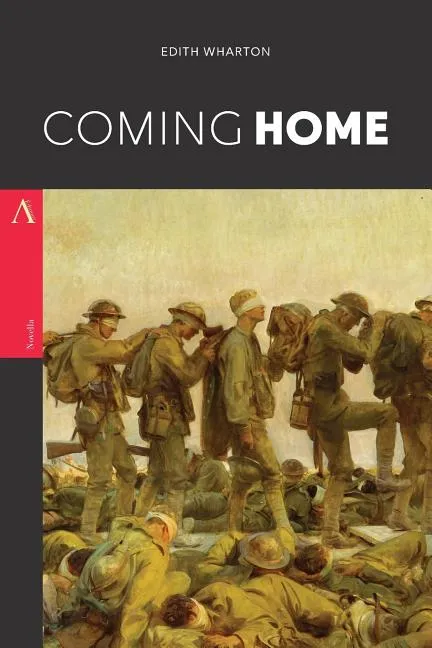
Coming Home
Report an issue
Tell us what's wrong and we'll take a look.
Thanks – we got it. We'll review and follow up if needed.
Full text.
Edith Wharton's First World War short story "Coming Home" was presented to its original readers in 1915-16 as an atrocity narrative-a distinctly contemporary text within Xingu and Other Stories, a book collection whose general emphasis is on old upper-class New York, cosmopolitan marital affairs, and haunted pasts. Early reviews of Coming Home placed it mainly as a well-constructed work that vividly depicts what had become in war propaganda commonplace themes of physical destruction and sexual trespass. Reviewers then and critics since have focused on the use of suppression and omission in the text. Yet this story of wartime atrocities in north-eastern France also enfolds within its layered focalization a meta-narrative containing some familiar topics in Wharton's fiction, including the emergence of female agency, patriarchal recidivism, the transformation of social hegemonies, and hereditary degeneration. If the story addresses received ideas of violation and retribution common in the genre of war-atrocity publications, it does so not only to play upon readers' anticipations of the unfolding plot, but also to explore deeper assumptions about social norms and gender expectations. Beyond that achievement, it poses questions about the reliability of language, thereby undermining the atrocity story genre itself and questioning the reliability of sources and the ability of any writer to represent the unfathomable nature of war. In this vortex of literary and philosophical complications, Coming Home adds a further existential complexity as it ultimately destabilizes the concept of home as a space of secure origins and grounded meaning.
Edith Wharton
Edith Wharton (1862-1937) was born into a distinguished New York family and was educated privately in the United States and abroad. Among her best-known work is Ethan Frome (1911), which is considered her greatest tragic story, The House of Mirth (1905), and The Age of Innocence (1920), for which she was awarded the Pulitzer Prize.
More by Edith Wharton




Why Readwise Books?
Readwise Books is an ebook & audiobook platform that automatically logs how much you and your friends read, making it fun and easy to read more. Learn more →