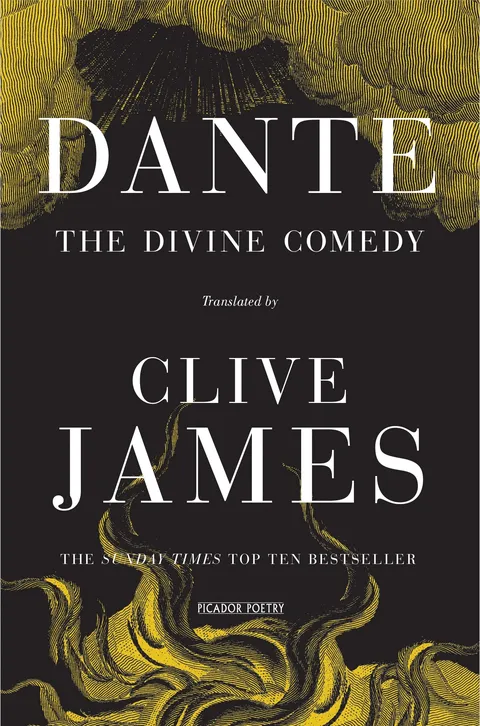
The Divine Comedy
Report an issue
Tell us what's wrong and we'll take a look.
Thanks – we got it. We'll review and follow up if needed.
‘Finally I realised that I had been practising for this job every time I wrote a quatrain . . . I had spent all this time – the greater part of a lifetime – preparing my instruments.’
The Divine Comedy is the precursor of modern literature, and Clive James’s vivid translation – his life’s work and decades in the making – presents Dante’s entire epic poem in a single song.
While many poets and translators have attempted to capture the full glory of The Divine Comedy in English, many have fallen short. Victorian verse translations established an unfortunate tradition of reproducing the sprightly rhyming measures of Dante but at the same time betraying the strain on the translator’s powers of invention. For Dante, the dramatic human stories of Hell were exciting, but the spiritual studies of Purgatory and the sublime panoramas of Heaven were no less so.
In this incantatory translation, James – defying the convention by writing in quatrains – tackles these problems head-on and creates a striking and hugely accessible translation that gives us The Divine Comedy as a whole, unified, and dramatic work.
Clive James
Clive James (1939-2019), author of the bestselling Cultural Amnesia and Poetry Notebook, was an Officer of the Order of Australia and a Commander of the Order of the British Empire. His writing appeared in the New York Times Book Review, The New Yorker, and The Atlantic.
More by Clive James
Dante
Dante was born in Florence, Italy, in 1265. Heir of a poor but noble family, he was one of the seven elected officials in charge of the government of Florence. Civil war was common in Florence at the time and the issues were further complicated by the question of Papal influence. In 1300, Dante along with his fellow magistrates confirmed anti-papal measures. When in 1302, the French prince acting under orders from the Pope captured power in Florence, Dante was sentenced on charges of corruption and opposition to the Church and exiled from Florence on pain of execution by burning if he ever returned. He spent the rest of his life in exile, pining for his native city. He withdrew from active politics to a large extent and concentrated on his literary creations.
We do not know exactly when Dante began work on The Divine Comedy. He had been moving about from court to court after his exile and 1n 1317 had settled at Ravenna, where he completed his great work. Extant correspondence shows that the first and second parts of The Divine Comedy, the "Inferno" and the "Purgatario" were generally known around 1319. The last part, the "Paradiso" was completed only in 1321. Dante died at Ravenna on 14 September 1321 and the last thirteen Cantos of the "Paradiso" were published posthumously.
More by Dante


Why Readwise Books?
Readwise Books is an ebook & audiobook platform that automatically logs how much you and your friends read, making it fun and easy to read more. Learn more →