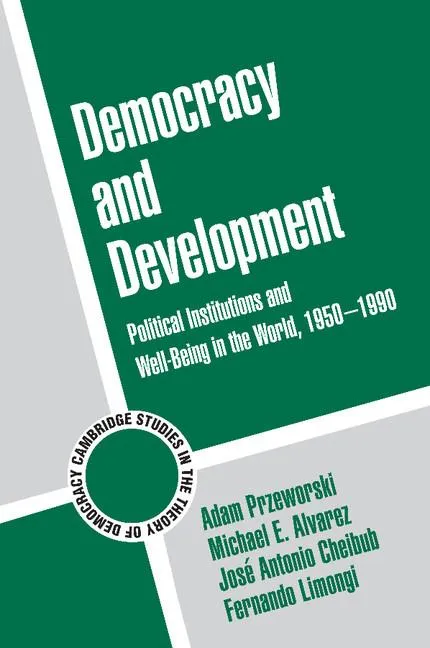
Democracy and Development
Political Institutions and Well-Being in the World, 1950 1990
Report an issue
Tell us what's wrong and we'll take a look.
Thanks – we got it. We'll review and follow up if needed.
Is economic development conducive to political democracy? Does democracy foster or hinder material welfare? These two questions are examined by looking at the experiences of 135 countries between 1950 and 1990. Descriptive information, statistical analyses, and historical narratives are interwoven to gain an understanding of the dynamic of political regimes and their impact on economic development. The often surprising findings dispel any notion of a tradeoff between democracy and development. Economic development does not generate democracies, but democracies are much more likely to survive in wealthy societies.
Jose Antonio Cheibub
José Antonio Cheibub is Associate Professor and Harold Boeschenstein Scholar in Political Economy and Public Policy at the University of Illinois, Urbana-Champaign. He earned his Ph.D. from the University of Chicago and has previously taught at the University of Pennsylvania and Yale University. He is a co-author of Democracy and Development: Political Institutions and Well-Being in the World, 1950-1990 (Cambridge, 2000), which won the 2001 Woodrow Wilson Foundation Award given by the American Political Science Association. He is also a co-editor of the Democracy Sourcebook (2003). Professor Cheibub has published articles in numerous edited volumes and journals, including Annual Review of Political Science, the British Journal of Political Science, Comparative Political Studies, the Journal of Democracy, and World Politics.


Why Readwise Books?
Readwise Books is an ebook & audiobook platform that automatically logs how much you and your friends read, making it fun and easy to read more. Learn more →