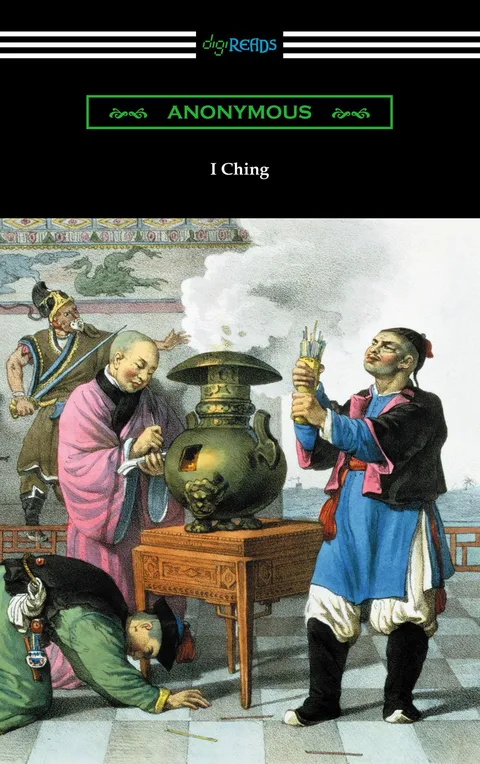
I Ching
Report an issue
Tell us what's wrong and we'll take a look.
Thanks – we got it. We'll review and follow up if needed.
Dating to the late ninth century B.C., the “I Ching, or, Book of Changes” is one of the oldest of the Chinese classics. What began as a manual for divination, the “I Ching” has been transformed through thousands of years of commentary and interpretation into one of the principal works of eastern cosmology. The central part of the work is the divination text, an explanation of hexagrams which may be produced through a process of cleromancy, a method of determining divine intent by the production of seemingly random numbers. Historically a casting of a bundle of stalks from the yarrow plant may have been used to produce the numbers which would build up the hexagram. Also part of the “I Ching” canon is a set of commentaries referred to as the “ten wings”, contained in the appendices of this volume. These commentaries are offered as a guide to moral decision making in interpreting the results of divination. The “I Ching”, having informed the philosophies of Taoism and Confucianism, remains to this day as one of the most influential of all ancient Chinese texts. This edition is translated with annotations by James Legge.
Anonymous
The anonymous author of A Woman in Berlin was a young woman at the time of the fall of Berlin. She was a journalist and editor during and after the war.
More by Anonymous





Why Readwise Books?
Readwise Books is an ebook & audiobook platform that automatically logs how much you and your friends read, making it fun and easy to read more. Learn more →